Entree: Italy – Lombardy – Frittura di Alborelle (Lombard-style lightly floured and deep-fried small freshwater fish served crisp)
Food safety reminder: Follow safe food-handling practices and use a food thermometer to verify safe internal cooking temperatures.
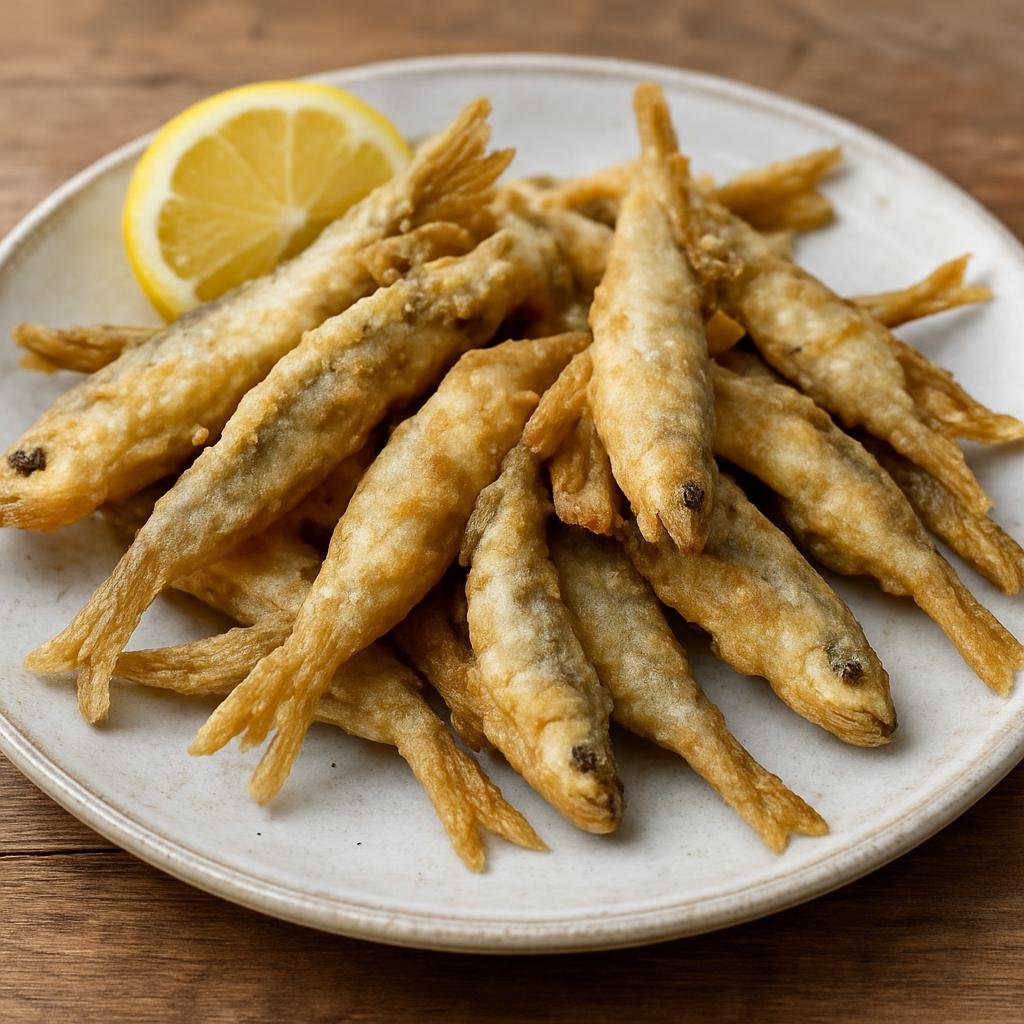
Serving Size: 4
Approximate Time
Prep
15 min
Cook
4 min
Total
20 min
Ingredients
- 1 lb (450 g) alborelle (small freshwater fish), cleaned and well drained
- 1 cup (120 g) all-purpose flour, plus extra for dredging
- 1/4 cup (35 g) fine cornmeal or semolina (optional, for extra crispness)
- 1 tsp (6 g) fine salt, plus coarse salt for finishing
- 1/2 tsp (1 g) freshly ground black pepper
- 4 cups (960 ml) vegetable oil for frying (peanut or sunflower oil recommended)
- 2 lemons, about 8 oz (225 g), cut into wedges
- 1/4 cup (15 g) fresh flat-leaf parsley, chopped
- Paper towels for draining
Instructions
1. Rinse and pat the alborelle very dry with paper towels; remove any remaining entrails and heads if preferred. Lightly season the fish with 1 tsp (6 g) fine salt and 1/2 tsp (1 g) black pepper and let sit 5–10 minutes.
2. In a shallow bowl combine 1 cup (120 g) all-purpose flour and 1/4 cup (35 g) cornmeal or semolina if using. Adjust seasoning with a pinch more salt.
3. Heat oil in a deep skillet or saucepan to 350–370°F (175–190°C). Use a thermometer to maintain temperature; the oil should be hot enough that a small pinch of flour sizzles immediately.
4. Dredge the fish lightly and evenly in the flour mixture, shaking off excess. Fry in batches so the fish have room and the oil temperature remains steady.
5. Fry each batch 1 to 2 minutes per side, until golden and crisp. Small alborelle cook very quickly; do not overcrowd the pan.
6. Remove with a slotted spoon and drain on paper towels. While hot, sprinkle with a little coarse sea salt and scatter chopped parsley over the fish.
7. Serve immediately with lemon wedges for squeezing and an extra pinch of coarse salt at the table.
Estimated Nutritional Information*
Per serving | Servings: 4
Calories: 374 kcal
Carbohydrates: 33 g
Protein: 24 g
Fat: 16.3 g
Saturated fat: 3.1 g
Cholesterol: 72 mg
Fiber: 2.5 g
Sugar: 1 g
Sodium: 671 mg
Potassium: 424 mg
Calcium: 84 mg
Iron: 2.97 mg
Vitamin A: 73 µg RAE
Vitamin C: 19.4 mg
Nutrition estimated: November 6, 2026
*Values are estimates based on USDA data and mathematical calculations. Actual values may vary. Where data are unavailable, those contributions are excluded. Calories, Carbohydrates, Protein, Fat, Saturated fat, Cholesterol, Fiber, Sodium, Potassium, Calcium, Iron, Vitamin A and Vitamin C are known subtotals. Sugar is a known subtotal, with data for 7 of 8 ingredients. Missing contributions are unknown, not zero.