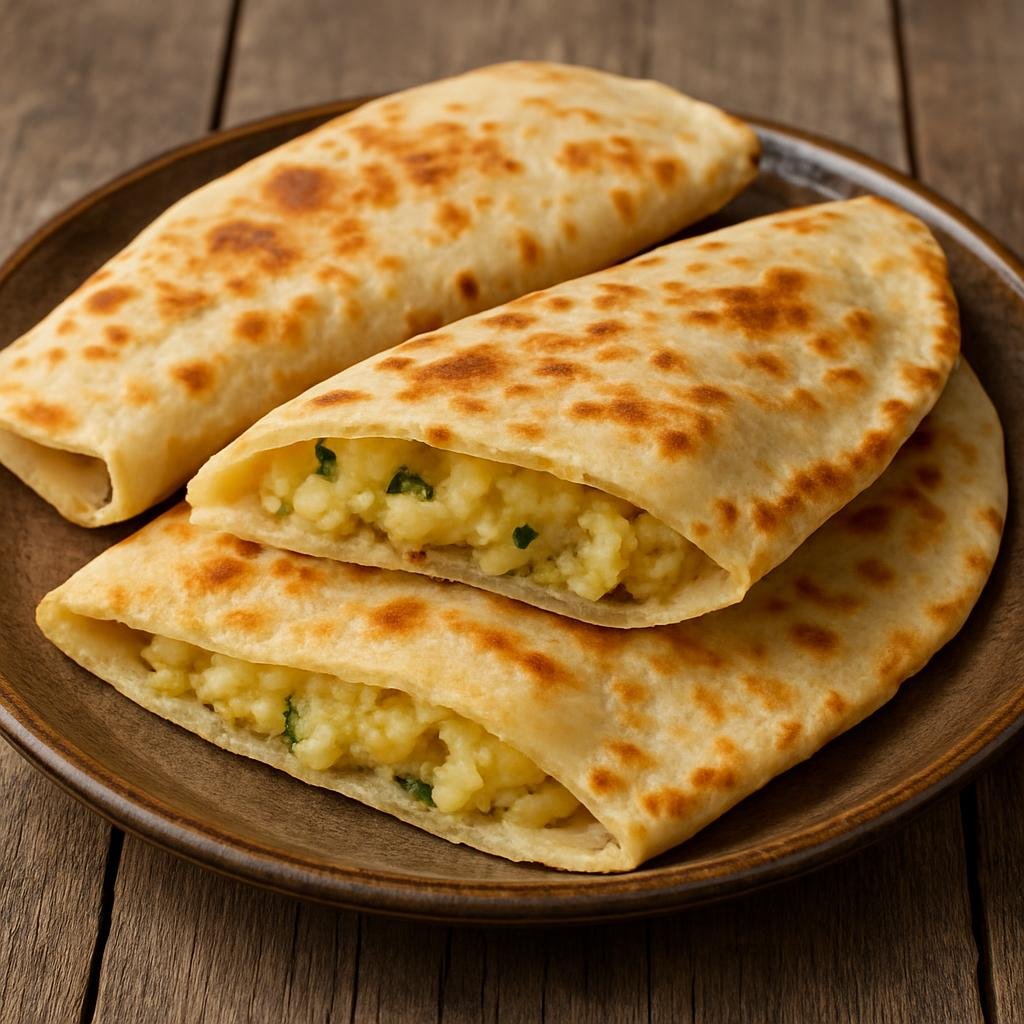
Entree: Russia – Volga Region – Кыстыбый ➤ Kystyby (Tatar-style thin flatbread folded around a seasoned mashed potato filling)
Food safety reminder: Follow safe food-handling practices and use a food thermometer to verify safe internal cooking temperatures.
Serving Size: 4
Approximate Time
Prep
30 min
Cook
5 min
Additional
15 min
Total
50 min
Ingredients
- 2 cups (250 g) all-purpose flour
- 1/2 tsp (3 g) salt, plus more for potatoes
- 3/4 cup (180 ml) warm milk
- 2 tbsp (30 ml) vegetable oil, plus extra for cooking
- 2 lb (900 g) russet or Yukon Gold potatoes, peeled and cut into chunks
- 4 tbsp (60 g) unsalted butter, divided
- 1 medium onion, finely chopped, about 5 oz (150 g)
- 1/4 tsp (1 g) black pepper
- 2 tbsp (30 ml) sour cream or plain yogurt (optional, for serving)
- Lemon wedges or additional butter for serving (optional)
Instructions
1. Step 1: Boil the potatoes in salted water until fork-tender, about 15–20 minutes; drain and mash with 2 tbsp (30 g) butter, 1/4 tsp (1 g) salt, and pepper until smooth. Keep warm.
2. Step 2: In a small skillet, sauté the chopped onion in 1 tbsp (15 g) butter over medium heat until soft and translucent, about 5–7 minutes; fold the onion into the mashed potatoes and adjust seasoning.
3. Step 3: In a bowl, combine the flour and 1/2 tsp (3 g) salt. Stir in the warm milk and 2 tbsp (30 ml) vegetable oil until a soft dough forms; knead briefly on a floured surface until smooth, about 2–3 minutes. Cover and let rest 15 minutes.
4. Step 4: Divide the dough into 8 equal pieces. Roll each into a ball and flatten/roll into a thin circle about 7–8 inches (18–20 cm) in diameter.
5. Step 5: Heat a dry cast-iron skillet or griddle over medium-high heat. Cook each flatbread 1–2 minutes per side until brown spots appear and the bread is cooked through.
6. Step 6: While hot, spread about 1/2 cup (120 g) of the mashed potato mixture over one half of each flatbread and fold the other half over to form a semicircle. Press gently to seal.
7. Step 7: Brush the folded bread with remaining melted butter and return to the skillet briefly, about 30 seconds per side, to warm through and crisp slightly.
8. Step 8: Serve hot, optionally with a dollop of sour cream or a lemon wedge.
Estimated Nutritional Information*
Per serving | Servings: 4
Calories: 624 kcal
Carbohydrates: 93.2 g
Protein: 13.2 g
Fat: 22.5 g
Saturated fat: 10.3 g
Cholesterol: 40 mg
Fiber: 7.1 g
Sugar: 6.1 g
Sodium: 330 mg
Potassium: 1153 mg
Calcium: 108 mg
Iron: 4.85 mg
Vitamin A: 131 µg RAE
Vitamin C: 47.2 mg
Vitamin D: 0.6 µg
Nutrition estimated: November 5, 2026
*Values are estimates based on USDA data and mathematical calculations. Actual values may vary. Where data are unavailable, those contributions are excluded. Calories, Carbohydrates, Protein, Fat, Saturated fat, Cholesterol, Fiber, Sugar, Sodium, Potassium, Calcium, Iron, Vitamin A, Vitamin C and Vitamin D are known subtotals. Missing contributions are unknown, not zero.