Entree: United States – Texas – Classic Texas Smoked Brisket
Food safety reminder: Follow safe food-handling practices and use a food thermometer to verify safe internal cooking temperatures.
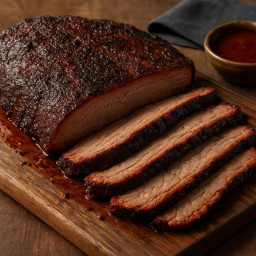
Serving Size: 8
Approximate Time
Prep
45 min
Cook
12 hrs
Additional
1 hr 30 min
Total
13 hrs 30 min
Ingredients
- 1 whole packer brisket, approx. 10 lb (4.5 kg) total
- 1/4 cup (60 g) coarse kosher salt
- 1/4 cup (40 g) coarsely ground black pepper
- 2 tbsp (30 ml) garlic powder
- 1 tbsp (15 ml) onion powder
- 1/4 cup (60 ml) yellow mustard (as binder)
- 1 cup (240 ml) beef broth (for pan and occasional spritz)
- 1 cup (240 ml) apple cider vinegar
- 1 cup (240 ml) water
- 2 tbsp (30 ml) Worcestershire sauce
- Post oak or hickory wood chunks for smoking (amount as needed)
Instructions
1. Trim brisket: remove silver skin and excess fat, leaving about 1/4 in (6 mm) fat cap; square the point and flat for even thickness.
2. Apply binder: lightly coat entire brisket with yellow mustard to help rub adhere.
3. Mix rub: combine kosher salt, black pepper, garlic powder, and onion powder; apply liberally and evenly over brisket, pressing to adhere. Refrigerate uncovered for 2–12 hours if possible.
4. Preheat smoker to 225–250°F (107–121°C) and set for indirect smoking with wood chunks added for steady smoke.
5. Place brisket fat-side up on smoker grates; insert probe thermometer into the thickest part of the flat.
6. Smoke unwrapped until internal temperature ~155–165°F (68–74°C), spritzing every 60–90 minutes with a mixture of 1/2 cup (120 ml) apple cider vinegar + 1/2 cup (120 ml) water + 1 tbsp (15 ml) Worcestershire if desired; this helps bark formation.
7. At the stall (~155–165°F / 68–74°C) wrap brisket tightly in butcher paper (preferred) or foil, then continue smoking until internal temperature reaches 195–203°F (90–95°C) and probe slides with little resistance.
8. Remove brisket, place on a tray, and rest wrapped in a cooler or insulated container for 1–2 hours to redistribute juices.
9. Unwrap, slice brisket thinly against the grain for the flat and across the grain for the point; serve warm with pan juices or your choice of sauce on the side.
Estimated Nutritional Information*
Per serving | Servings: 8
Calories: 39 kcal
Carbohydrates: 7.3 g
Protein: 1.4 g
Fat: 0.5 g
Saturated fat: 0.1 g
Fiber: 1.9 g
Sugar: 0.8 g
Sodium: 3132 mg
Potassium: 174 mg
Calcium: 43 mg
Iron: 1.1 mg
Vitamin A: 2 µg RAE
Vitamin C: 0.8 mg
Nutrition estimated: November 5, 2026
*Values are estimates based on USDA data and mathematical calculations. Actual values may vary. Where data are unavailable, those contributions are excluded. Calories, Carbohydrates, Protein, Fat, Saturated fat, Fiber, Sugar, Sodium, Potassium, Calcium, Iron, Vitamin A and Vitamin C are known subtotals. Missing contributions are unknown, not zero.