Entree: United States – Texas – Texas Smoked Whole Turkey
Food safety reminder: Follow safe food-handling practices and use a food thermometer to verify safe internal cooking temperatures.
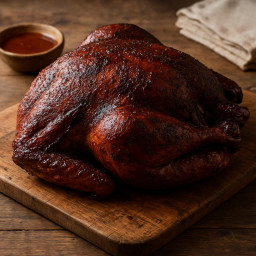
Serving Size: 8
Approximate Time
Prep
45 min
Cook
3 hrs 30 min
Additional
30 min
Total
4 hrs 45 min
Ingredients
- 1 whole turkey, approx. 12 lb (5.4 kg) total
- 1/4 cup (60 g) coarse kosher salt
- 2 tbsp (30 g) coarsely ground black pepper
- 2 tbsp (30 ml) smoked paprika
- 1 tbsp (15 ml) garlic powder
- 1 tbsp (15 ml) onion powder
- 1/4 cup (60 ml) yellow mustard (as binder)
- 1/2 cup (120 ml) unsalted butter, softened
- 1 cup (240 ml) apple cider (for the drip pan)
- 3–4 sprigs fresh thyme and 2–3 sprigs fresh rosemary (optional)
- Pecan or oak wood chunks for smoking (amount as needed)
Instructions
1. Prepare turkey: remove neck and giblets, pat turkey dry inside and out, and tuck wing tips behind shoulders; loosely truss legs if desired.
2. Apply binder: rub softened butter and yellow mustard under and over the skin where possible and over exterior to help seasoning and browning.
3. Mix rub: combine kosher salt, black pepper, smoked paprika, garlic powder, and onion powder; rub evenly over entire turkey, including cavity. Insert thyme and rosemary into cavity if using.
4. Refrigerate uncovered for a few hours or overnight to dry the skin for better bark, or let sit at room temperature 30–60 minutes before smoking.
5. Preheat smoker to 275°F (135°C) and arrange for indirect heat with wood chunks for smoke; place a drip pan with 1 cup (240 ml) apple cider beneath the turkey to catch drippings and add moisture.
6. Smoke turkey breast-side up until internal temperature in the thickest part of the breast reaches 160–165°F (71–74°C) and the thigh reaches 175–180°F (79–82°C), about 3–4 hours for a 12 lb (5.4 kg) bird (times vary).
7. If breast is browning too fast, tent with foil. For crisper skin, remove foil and raise heat to 325°F (163°C) for the final 10–15 minutes.
8. Remove turkey, tent loosely with foil, and rest 20–30 minutes before carving to allow juices to redistribute; carve and serve warm.
Estimated Nutritional Information*
Per serving | Servings: 8
Calories: 832 kcal
Carbohydrates: 9.5 g
Protein: 105.1 g
Fat: 39.2 g
Saturated fat: 14.3 g
Cholesterol: 376 mg
Fiber: 2.2 g
Sugar: 3.7 g
Sodium: 3536 mg
Potassium: 1232 mg
Calcium: 90 mg
Iron: 5.14 mg
Vitamin A: 222 µg RAE
Vitamin C: 12.2 mg
Vitamin D: 1.4 µg
Nutrition estimated: November 5, 2026
*Values are estimates based on USDA data and mathematical calculations. Actual values may vary. Where data are unavailable, those contributions are excluded. Calories, Carbohydrates, Protein, Fat, Saturated fat, Cholesterol, Fiber, Sugar, Sodium, Potassium, Calcium, Iron, Vitamin A, Vitamin C and Vitamin D are known subtotals. Missing contributions are unknown, not zero.