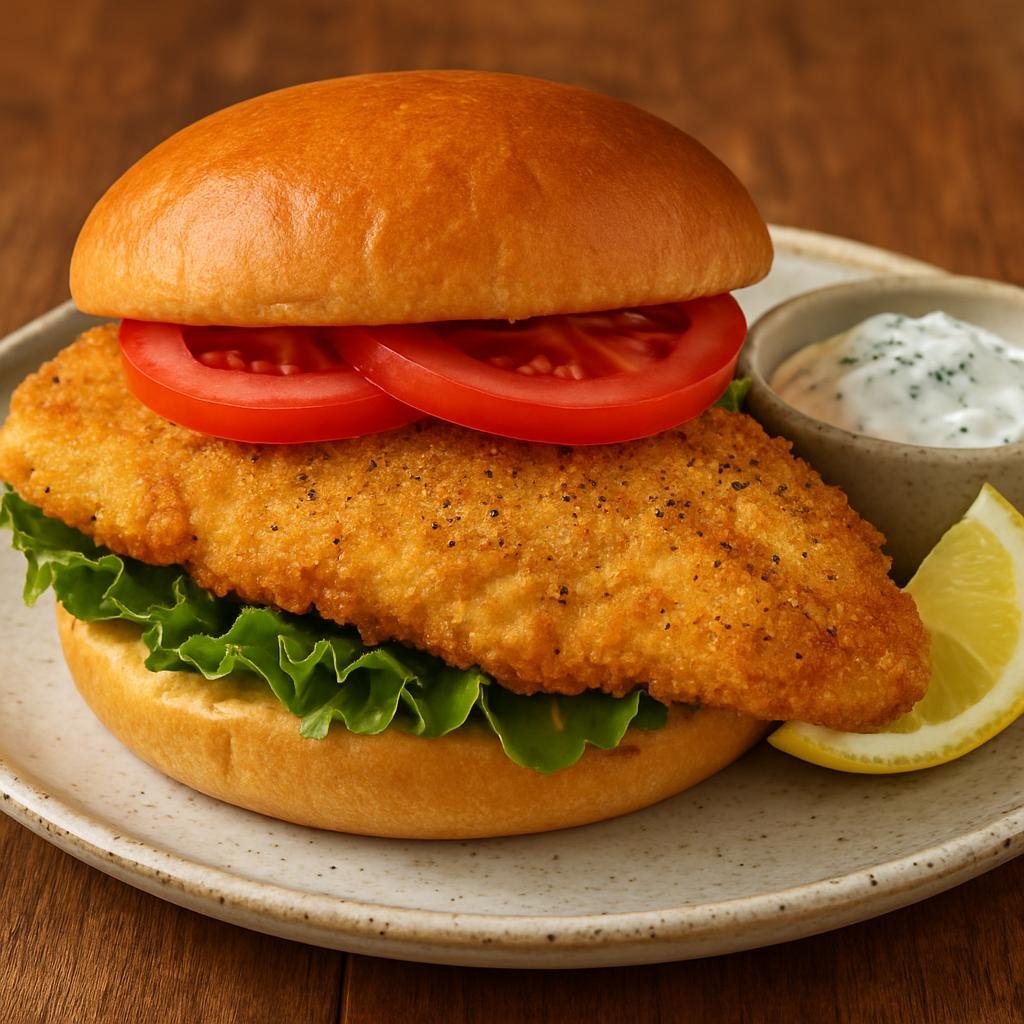
Entree: United States – Upper Midwest (Minnesota) – Walleye Sandwich
Food safety reminder: Follow safe food-handling practices and use a food thermometer to verify safe internal cooking temperatures.
Serving Size: 4
Approximate Time
Prep
10 min
Cook
15 min
Additional
10 min
Total
35 min
Ingredients
- 1.5 lb (680 g) walleye fillets, portioned into 4 fillets, approx. 6 oz (170 g) each
- 4 brioche or hamburger buns
- 4 large lettuce leaves (iceberg or romaine)
- 1 medium tomato, sliced
- 1 lemon, cut into 4 wedges
- Salt and black pepper

For the pan-fry dredge (classic):
- 3/4 cup (95 g) all-purpose flour
- 3/4 cup (120 g) yellow cornmeal
- 1 1/2 tsp (6 g) kosher salt
- 1 tsp (2 g) smoked paprika or sweet paprika
- 1/2 tsp (1.5 g) garlic powder
- 1/4 tsp (0.5 g) cayenne pepper (optional)
- 1/2 cup (120 ml) vegetable oil or canola oil, for shallow frying (more as needed)

For the grilled option (alternate):
- 2 tbsp (30 ml) olive oil
- 1 tbsp (15 ml) lemon juice
- 1 tsp (2 g) Dijon mustard
- 1/2 tsp (1 g) dried dill or 1 tbsp (3 g) chopped fresh dill
- 1/4 tsp (1 g) black pepper
- 1/2 tsp (3 g) kosher salt

Tartar sauce:
- 1/2 cup (120 ml) mayonnaise
- 2 tbsp (30 ml) dill pickle relish
- 1 tbsp (15 ml) lemon juice
- 1 tsp (5 g) Dijon mustard
- 1 tbsp (3 g) chopped fresh parsley or dill (optional)
- Salt and black pepper to taste

Oven-baked potato wedges (side):
- 1.5 lb (680 g) russet potatoes, scrubbed and cut into wedges
- 2 tbsp (30 ml) olive oil
- 1 tsp (5 g) kosher salt
- 1/2 tsp (1 g) black pepper
- 1/2 tsp (1.5 g) smoked paprika
Instructions
Short Description:
Crisp pan-fried or grilled walleye fillets served on toasted buns with lettuce, tomato, and a tangy homemade tartar sauce, accompanied by oven-baked potato wedges for a complete Upper Midwest meal.

Regional Notes:
This Minnesota/Upper Midwest version highlights local freshwater walleye—light, flaky, and mild—typically simply crusted and pan-fried or grilled and finished with lemon and tartar sauce. Unlike coastal preparations, it uses freshwater fillets and a straightforward cornmeal/seasoned-flour dredge or a lemon-herb grill treatment, served on a soft bun with classic sides like potato wedges.

1. Preheat oven to 425°F (220°C). Line a baking sheet with foil and set a wire rack on top if available.
2. Make tartar sauce: in a small bowl combine mayonnaise, dill pickle relish, lemon juice, Dijon mustard, and chopped parsley or dill. Season with salt and pepper, taste, and refrigerate until ready.
3. Prepare potato wedges: toss potato wedges with olive oil, salt, pepper, and smoked paprika. Spread in a single layer on the prepared baking sheet and bake 25–30 minutes, turning once, until golden and crisp. Keep warm.
4. Choose cooking method for the walleye:
   - Pan-fry (classic Upper Midwest): In a shallow dish whisk together flour, cornmeal, salt, paprika, garlic powder, and cayenne. Pat fillets dry and season lightly with salt and pepper. Dredge each fillet in the flour-cornmeal mixture, pressing to adhere. Heat vegetable oil in a large skillet over medium-high heat until shimmering (about 350°F / 175°C in a thermometer or test with a pinch of dredge — it should sizzle). Cook fillets 3–4 minutes per side, depending on thickness, until golden brown and fish flakes easily (internal temp ~145°F / 63°C). Transfer to a paper-towel-lined plate briefly to drain.
   - Grill (lighter option): Whisk olive oil, lemon juice, Dijon, dill, salt, and pepper. Brush fillets with the marinade and oil a clean grill grates. Preheat grill to medium-high. Grill fillets 3–4 minutes per side, flipping once, until grill marks form and fish flakes easily.
5. Toast buns: split and lightly toast buns on grill or in a skillet until golden (about 1–2 minutes).
6. Assemble sandwiches: spread 1–2 tbsp (15–30 ml) tartar sauce on bottom bun, add lettuce leaf, tomato slice, place a walleye fillet on top, add another small spoonful of tartar sauce if desired, then top bun. Serve with oven-baked potato wedges and lemon wedge alongside.
7. Serve immediately: offer extra tartar sauce and lemon wedges. Leftover tartar keeps refrigerated for up to 3 days; cooked fillets are best eaten same day.
Estimated Nutritional Information*
Per serving | Servings: 4
Calories: 906 kcal
Carbohydrates: 79.3 g
Protein: 9.3 g
Fat: 62.7 g
Saturated fat: 9.6 g
Cholesterol: 12 mg
Fiber: 7.1 g
Sodium: 1630 mg
Potassium: 966 mg
Calcium: 47 mg
Iron: 4.64 mg
Vitamin A: 60 µg RAE
Vitamin C: 50.6 mg
Vitamin D: 0.1 µg
Nutrition estimated: November 5, 2026
*Values are estimates based on USDA data and mathematical calculations. Actual values may vary. Where data are unavailable, those contributions are excluded. Calories, Carbohydrates, Protein, Fat, Saturated fat, Cholesterol, Fiber, Sodium, Potassium, Calcium, Iron, Vitamin A, Vitamin C and Vitamin D are known subtotals. Missing contributions are unknown, not zero.