Side Dish: Canada – Northwest Territories – Bannock
Food safety reminder: Follow safe food-handling practices and use a food thermometer to verify safe internal cooking temperatures.
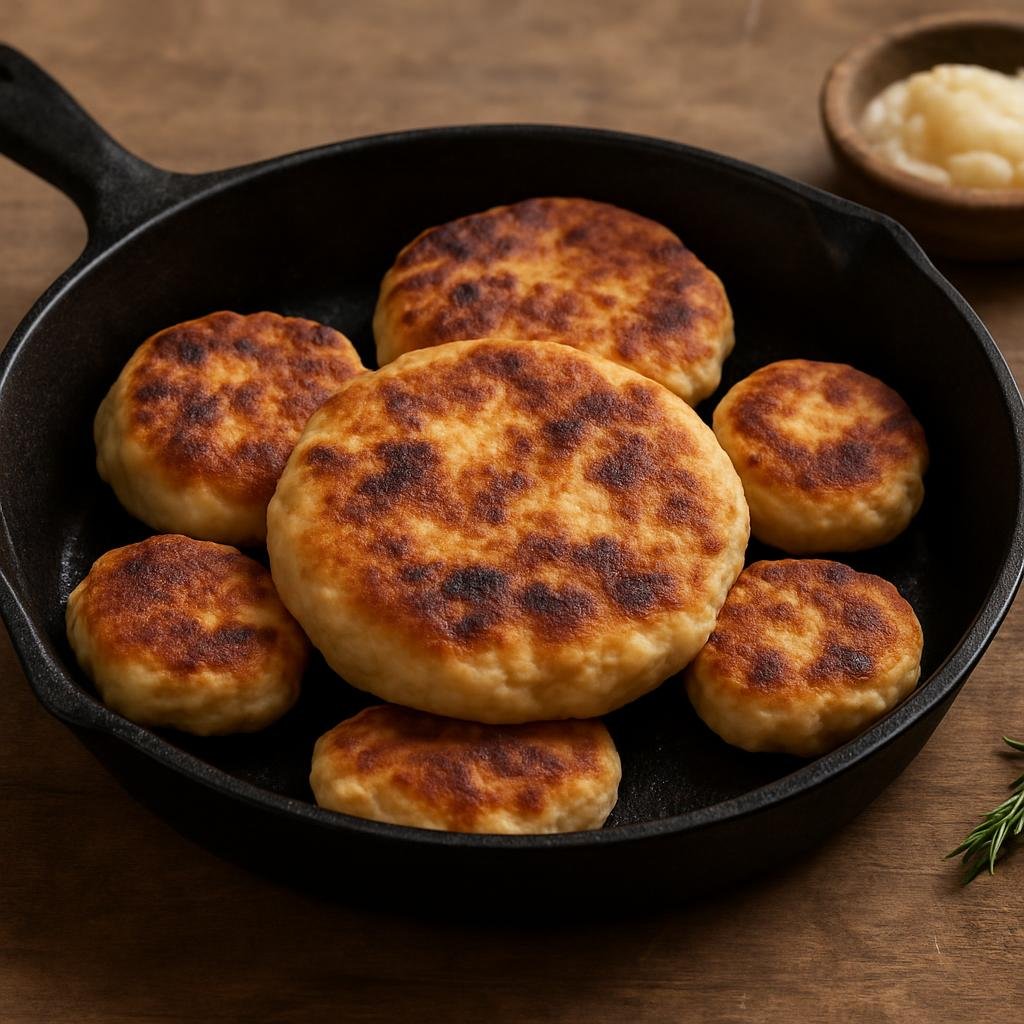
Serving Size: 6
Approximate Time
Prep
20 min
Cook
25 min
Additional
5 min
Total
50 min
Ingredients
- 3 cups (360 g) all-purpose flour
- 1 tbsp (15 g) baking powder
- 1 tsp (5 g) fine salt
- 2 tbsp (25 g) granulated sugar (optional)
- 3 tbsp (42 g) cold unsalted butter or lard, cut into pieces
- 1 cup (240 ml) warm water or milk (plus up to 1/4 cup (60 ml) extra as needed)
- 2 tbsp (30 ml) rendered tallow, lard, or bacon fat, divided (optional; use for richer dough and smoky flavor)
- 1-2 tbsp (15-30 ml) neutral oil or extra fat for the skillet
- 2 tbsp (18 g) extra flour for dusting
- 1/2 cup (75 g) dried or fresh wild berries (blueberries/cloudberries) (optional)
- Butter and wild berry jam for serving (optional)
Instructions
U.S. measurements first, metric equivalents in parentheses. Conversions are approximate.
Short Description:
A rustic, dense flatbread traditionally cooked in a hot cast iron pan or over an open fire; crisp and slightly smoky on the outside with a soft crumb inside. Served plain, with butter, or alongside soups, stews, and wild berry preserves.

Regional Notes:
This Northwest Territories version emphasizes locally sourced ingredients and optional rendered animal fat for authenticity, and is cooked in a hot cast iron skillet or directly on hot coals to develop the characteristic smoky flavor. Smaller individual rounds or a single thick disk are both common depending on camp or kitchen setup.

1. Prepare fire or skillet: if using a cast iron skillet on a stovetop, set over medium-high heat until hot; if outdoors, have hot coals set aside for cooking. If baking instead, preheat oven to 400°F (200°C) and place a cast iron skillet or baking sheet inside to heat.
2. In a large bowl combine the flour, baking powder, salt, and sugar (if using). Stir to blend evenly.
3. Cut the cold butter or lard into the dry mix with a pastry cutter or your fingertips until the mixture resembles coarse crumbs (pea-sized pieces).
4. Stir in 1 tbsp (15 ml) of the rendered tallow (if using) and then pour in the warm water or milk. Mix gently with a wooden spoon until a shaggy, slightly sticky dough forms. Fold in the berries if using. Add up to 1/4 cup (60 ml) more liquid only if the dough is too dry.
5. Turn the dough onto a lightly floured surface (use about 2 tbsp (18 g) flour) and knead very briefly — 6 to 8 turns just to bring it together. Pat or roll into a single disk about 1 in (2.5 cm) thick (or divide into 6 smaller rounds about 1/2 in (1.2 cm) thick for individual bannocks).
6. Heat the skillet: add 1 tbsp (15 ml) oil or reserved tallow to the hot cast iron and swirl to coat. For campfire cooking, spread fat on a hot flat rock or in the skillet over coals.
7. Cook the bannock: place the whole disk or individual rounds in the hot skillet. Cover with a lid or tent with foil to trap heat (or position them a short distance from coals). Cook until the bottom is golden and crisp, about 8–12 minutes for small rounds or 12–18 minutes for a single thick disk.
8. Flip and cook the other side until golden and a skewer inserted in the center comes out clean, another 6–12 minutes depending on thickness. Adjust heat to avoid burning; move to cooler coals or lower the burner if browning too quickly.
9. Oven alternative: bake the shaped disk or rounds on the preheated skillet or sheet for 20–25 minutes until golden and cooked through.
10. Rest and serve: let bannock rest 5 minutes, then split or tear and serve warm with butter, wild berry jam, or alongside soups and stews. The exterior should have a subtle smoky note when cooked over open fire or in well-seasoned cast iron.
Show original instructions
Short Description:
A rustic, dense flatbread traditionally cooked in a hot cast iron pan or over an open fire; crisp and slightly smoky on the outside with a soft crumb inside. Served plain, with butter, or alongside soups, stews, and wild berry preserves.

Regional Notes:
This Northwest Territories version emphasizes locally sourced ingredients and optional rendered animal fat for authenticity, and is cooked in a hot cast iron skillet or directly on hot coals to develop the characteristic smoky flavor. Smaller individual rounds or a single thick disk are both common depending on camp or kitchen setup.

1. Prepare fire or skillet: if using a cast iron skillet on a stovetop, set over medium-high heat until hot; if outdoors, have hot coals set aside for cooking. If baking instead, preheat oven to 400°F (200°C) and place a cast iron skillet or baking sheet inside to heat.
2. In a large bowl combine the flour, baking powder, salt, and sugar (if using). Stir to blend evenly.
3. Cut the cold butter or lard into the dry mix with a pastry cutter or your fingertips until the mixture resembles coarse crumbs (pea-sized pieces).
4. Stir in 1 tbsp (15 ml) of the rendered tallow (if using) and then pour in the warm water or milk. Mix gently with a wooden spoon until a shaggy, slightly sticky dough forms. Fold in the berries if using. Add up to 1/4 cup (60 ml) more liquid only if the dough is too dry.
5. Turn the dough onto a lightly floured surface (use about 2 tbsp / 18 g flour) and knead very briefly — 6 to 8 turns just to bring it together. Pat or roll into a single disk about 1 in (2.5 cm) thick (or divide into 6 smaller rounds about 1/2 in (1.2 cm) thick for individual bannocks).
6. Heat the skillet: add 1 tbsp (15 ml) oil or reserved tallow to the hot cast iron and swirl to coat. For campfire cooking, spread fat on a hot flat rock or in the skillet over coals.
7. Cook the bannock: place the whole disk or individual rounds in the hot skillet. Cover with a lid or tent with foil to trap heat (or position them a short distance from coals). Cook until the bottom is golden and crisp, about 8–12 minutes for small rounds or 12–18 minutes for a single thick disk.
8. Flip and cook the other side until golden and a skewer inserted in the center comes out clean, another 6–12 minutes depending on thickness. Adjust heat to avoid burning; move to cooler coals or lower the burner if browning too quickly.
9. Oven alternative: bake the shaped disk or rounds on the preheated skillet or sheet for 20–25 minutes until golden and cooked through.
10. Rest and serve: let bannock rest 5 minutes, then split or tear and serve warm with butter, wild berry jam, or alongside soups and stews. The exterior should have a subtle smoky note when cooked over open fire or in well-seasoned cast iron.
Estimated Nutritional Information*
Per serving | Servings: 6
Calories: 366 kcal
Carbohydrates: 52.9 g
Protein: 6.6 g
Fat: 14 g
Saturated fat: 5.8 g
Cholesterol: 19 mg
Fiber: 1.7 g
Sugar: 4.3 g
Sodium: 592 mg
Potassium: 70 mg
Calcium: 159 mg
Iron: 3.21 mg
Vitamin A: 48 µg RAE
Vitamin D: 0.1 µg
Nutrition estimated: November 5, 2026
*Values are estimates based on USDA data and mathematical calculations. Actual values may vary. Where data are unavailable, those contributions are excluded. Calories, Carbohydrates, Protein, Fat, Saturated fat, Cholesterol, Fiber, Sugar, Sodium, Potassium, Calcium, Iron, Vitamin A and Vitamin D are known subtotals. Missing contributions are unknown, not zero.