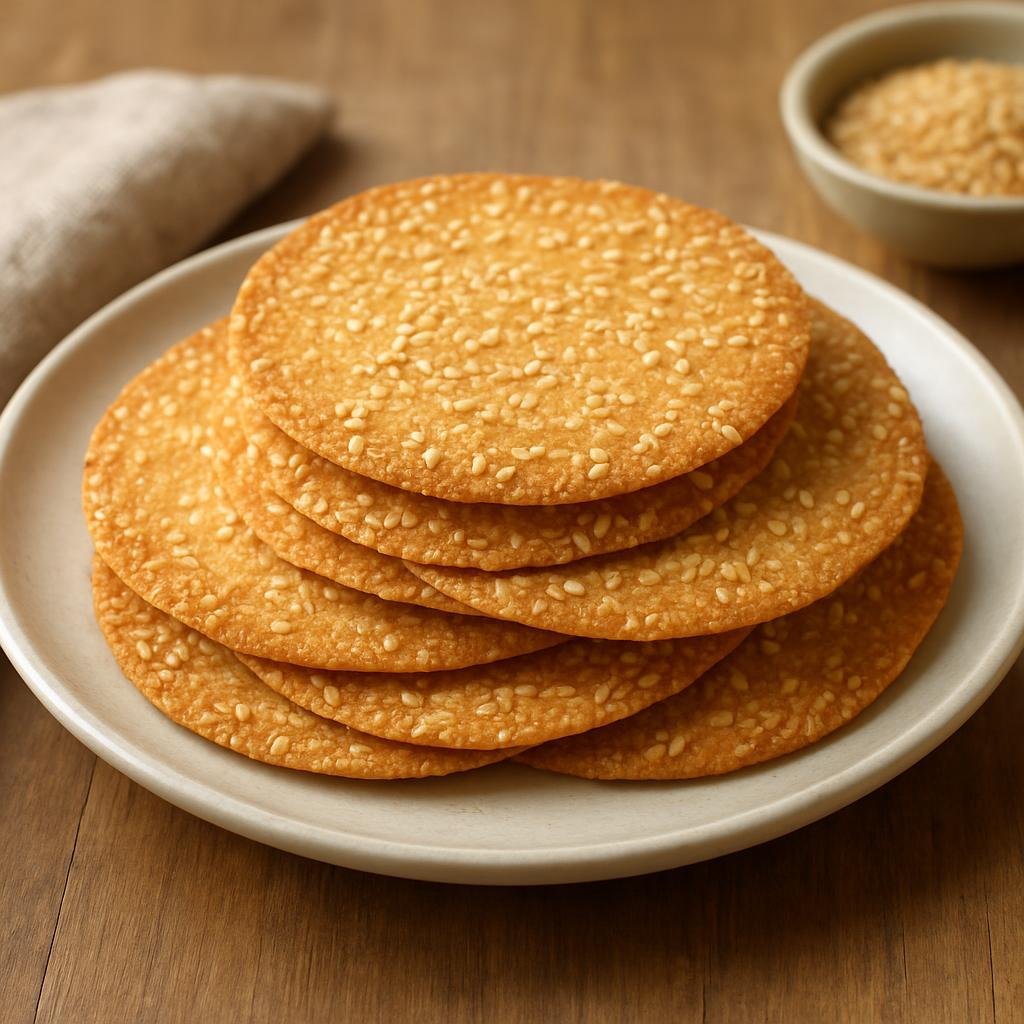
Dessert: United States – South Carolina, Southern United States – Benne Wafers
Food safety reminder: Follow safe food-handling practices and use a food thermometer to verify safe internal cooking temperatures.
Ingredients
U.S. measurements first, metric equivalents in parentheses. Conversions are approximate; oz means weight ounces, not fluid ounces.
- 1/2 cup (120 ml) (1 stick, 4 oz (113 g)) unsalted butter, melted and slightly cooled
- 1 cup (200 g) granulated sugar
- 2 large egg whites, approx. 2 1/8 oz (60 g) (from about 2 large eggs)
- 1 cup (120 g) all-purpose flour
- 1/3 cup (50 g) benne seeds (sesame seeds), lightly toasted
- 1 tsp (5 ml) vanilla extract
- 1/4 tsp (1.5 g) fine salt
- 1/4 tsp (1 g) baking powder (optional; helps very slightly with lift)
- Parchment paper or silicone baking mat (no measurement)
Show original ingredient measurements
- 1/2 cup (1 stick, 113 g) unsalted butter, melted and slightly cooled
- 1 cup (200 g) granulated sugar
- 2 large egg whites, approx. 60 g (from about 2 large eggs)
- 1 cup (120 g) all-purpose flour
- 1/3 cup (50 g) benne seeds (sesame seeds), lightly toasted
- 1 tsp (5 ml) vanilla extract
- 1/4 tsp (1.5 g) fine salt
- 1/4 tsp (1 g) baking powder (optional; helps very slightly with lift)
- Parchment paper or silicone baking mat (no measurement)
Instructions
U.S. measurements first, metric equivalents in parentheses. Conversions are approximate.
Short Description:
Thin, crisp cookies made with roasted benne seeds (a Southern term for sesame seeds) that yield a delicate, nutty, slightly caramelized cookie often served as a simple Southern dessert or tea-time treat.

Regional Notes:
This South Carolina version uses benne seeds—a term preserved in Gullah/Geechee and Lowcountry cooking—to honor the African seed brought by enslaved people; the intense nutty flavor and very thin, crackly texture distinguish these from generic sesame cookies elsewhere. The wafers are traditionally baked very thin and sometimes shaped while hot into a curl or left flat to accentuate crispness.

1. Preheat the oven to 350°F (175°C). Line two baking sheets with parchment paper or silicone mats.
2. Lightly toast the benne seeds in a dry skillet over medium heat, stirring, until fragrant and just beginning to color, 2–3 minutes. Transfer to a small bowl to cool.
3. In a medium bowl, whisk the melted butter and granulated sugar until well combined and slightly glossy.
4. Add the egg whites and vanilla extract to the butter-sugar mixture and whisk until smooth.
5. Sift together the all-purpose flour, salt, and baking powder (if using) into the wet mixture. Fold gently with a spatula until just combined; the batter should be pourable but not runny—if too thick, stir in a teaspoon of water.
6. Fold in the toasted benne seeds until evenly distributed.
7. Using a teaspoon or small cookie scoop, drop about 1/2 teaspoon (2.5 ml) (a scant teaspoon) of batter onto the prepared sheets, spacing each about 2–3 inches (5.08 to 7.62 cm) apart. Quickly, using the back of a spoon or an offset spatula lightly dipped in water, spread each mound into a thin circle about 2–2.5 inches (5–6 cm) across. Thin spreading is key to the wafer crispness.
8. Bake one sheet at a time on the middle rack until edges are golden-brown and centers are set, 8–10 minutes (watch closely; edges brown quickly).
9. Remove the sheet from the oven. If you want curved wafers, immediately lift each hot wafer with a thin spatula and drape it over a rolling pin or bottle to cool and set in a curl; otherwise leave flat on the sheet to cool completely. They will crisp further as they cool.
10. Cool the wafers completely on a wire rack. Store in an airtight container at room temperature for up to 5 days; they are best within 2–3 days for maximum crispness.
Show original instructions
Short Description:
Thin, crisp cookies made with roasted benne seeds (a Southern term for sesame seeds) that yield a delicate, nutty, slightly caramelized cookie often served as a simple Southern dessert or tea-time treat.

Regional Notes:
This South Carolina version uses benne seeds—a term preserved in Gullah/Geechee and Lowcountry cooking—to honor the African seed brought by enslaved people; the intense nutty flavor and very thin, crackly texture distinguish these from generic sesame cookies elsewhere. The wafers are traditionally baked very thin and sometimes shaped while hot into a curl or left flat to accentuate crispness.

1. Preheat the oven to 350°F (175°C). Line two baking sheets with parchment paper or silicone mats.
2. Lightly toast the benne seeds in a dry skillet over medium heat, stirring, until fragrant and just beginning to color, 2–3 minutes. Transfer to a small bowl to cool.
3. In a medium bowl, whisk the melted butter and granulated sugar until well combined and slightly glossy.
4. Add the egg whites and vanilla extract to the butter-sugar mixture and whisk until smooth.
5. Sift together the all-purpose flour, salt, and baking powder (if using) into the wet mixture. Fold gently with a spatula until just combined; the batter should be pourable but not runny—if too thick, stir in a teaspoon of water.
6. Fold in the toasted benne seeds until evenly distributed.
7. Using a teaspoon or small cookie scoop, drop about 1/2 teaspoon (a scant teaspoon) of batter onto the prepared sheets, spacing each about 2–3 inches apart. Quickly, using the back of a spoon or an offset spatula lightly dipped in water, spread each mound into a thin circle about 2–2.5 inches (5–6 cm) across. Thin spreading is key to the wafer crispness.
8. Bake one sheet at a time on the middle rack until edges are golden-brown and centers are set, 8–10 minutes (watch closely; edges brown quickly).
9. Remove the sheet from the oven. If you want curved wafers, immediately lift each hot wafer with a thin spatula and drape it over a rolling pin or bottle to cool and set in a curl; otherwise leave flat on the sheet to cool completely. They will crisp further as they cool.
10. Cool the wafers completely on a wire rack. Store in an airtight container at room temperature for up to 5 days; they are best within 2–3 days for maximum crispness.
Per serving | Servings: 36
Nutrition estimated: November 5, 2026
*Values are estimates based on USDA data and mathematical calculations. Actual values may vary. Where data are unavailable, those contributions are excluded. Calories, Carbohydrates, Protein, Fat, Saturated fat, Cholesterol, Fiber, Sodium, Potassium, Calcium, Iron and Vitamin A are known subtotals. Missing contributions are unknown, not zero.