Entree: France – Poulet rôti (roast chicken)
Food safety reminder: Follow safe food-handling practices and use a food thermometer to verify safe internal cooking temperatures.
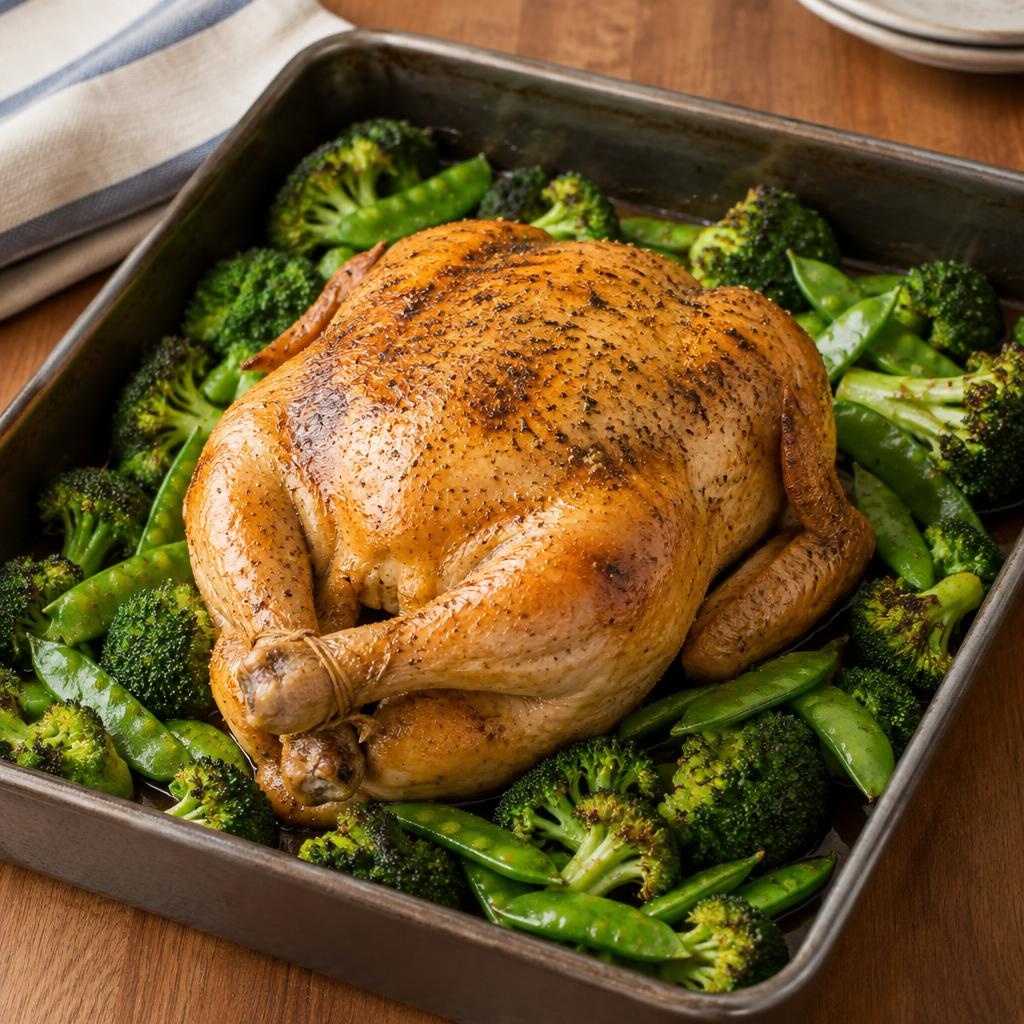
Serving Size: 4
Ingredients
- 1 whole chicken, approx. 4 lb (1.8 kg) total (suggested example: whole roasting chicken; used for nutrition estimate)
- 2 cups (170 g) broccoli florets
- 6 oz (170 g) snow peas
- salt, to taste
- black pepper, to taste
Instructions
U.S. measurements first, metric equivalents in parentheses. Conversions are approximate.
1. Preheat the oven to 425 F (220 C). Position a rack in the lower-middle third of the oven and prepare a roasting pan large enough to hold the bird without crowding (a 13 x 9 inch (23 cm) / 33 x 9 in (23 cm) pan or a shallow roasting pan).
2. Pat the chicken dry inside and out with paper towels. Truss the legs with kitchen twine or tuck the wing tips under the body. Season the cavity and the outside evenly with salt, to taste, and black pepper, to taste. Place the chicken breast-side up on a rack in the roasting pan.
3. Roast the chicken at 425 F (220 C) for 15 minutes to help color the skin. After 15 minutes reduce the oven temperature to 375 F (190 C) and continue roasting.
4. Estimate roasting time at about 15–20 minutes per pound after lowering the temperature; for a 4 lb (1.8 kg) bird expect approximately 1 hour to 1 hour 15 minutes more. Begin checking temperature about 15 minutes before the estimated finish time.
5. When there are roughly 20–25 minutes remaining on the roast time, add the broccoli florets and snow peas to the pan around the chicken in a single layer. Do not add oil; the vegetables will roast in the pan juices. Season the vegetables lightly with salt, to taste, and black pepper, to taste.
6. Continue roasting until an instant-read thermometer inserted into the thickest part of the thigh (avoiding bone) reads 165 F (74 C). The juices should run clear when the thigh is pierced.
7. Remove the pan from the oven and transfer the chicken to a cutting board. Tent loosely with foil and rest 10–15 minutes before carving to allow juices to redistribute. The roasted broccoli and snow peas may be served directly from the pan alongside carved chicken pieces.
8. Carve the chicken into portions and serve with the roasted vegetables. Adjust salt and pepper at the table if desired.
Show original instructions
1. Preheat the oven to 425 F (220 C). Position a rack in the lower-middle third of the oven and prepare a roasting pan large enough to hold the bird without crowding (a 13 x 9 inch / 33 x 23 cm pan or a shallow roasting pan).
2. Pat the chicken dry inside and out with paper towels. Truss the legs with kitchen twine or tuck the wing tips under the body. Season the cavity and the outside evenly with salt, to taste, and black pepper, to taste. Place the chicken breast-side up on a rack in the roasting pan.
3. Roast the chicken at 425 F (220 C) for 15 minutes to help color the skin. After 15 minutes reduce the oven temperature to 375 F (190 C) and continue roasting.
4. Estimate roasting time at about 15–20 minutes per pound after lowering the temperature; for a 4 lb (1.8 kg) bird expect approximately 1 hour to 1 hour 15 minutes more. Begin checking temperature about 15 minutes before the estimated finish time.
5. When there are roughly 20–25 minutes remaining on the roast time, add the broccoli florets and snow peas to the pan around the chicken in a single layer. Do not add oil; the vegetables will roast in the pan juices. Season the vegetables lightly with salt, to taste, and black pepper, to taste.
6. Continue roasting until an instant-read thermometer inserted into the thickest part of the thigh (avoiding bone) reads 165 F (74 C). The juices should run clear when the thigh is pierced.
7. Remove the pan from the oven and transfer the chicken to a cutting board. Tent loosely with foil and rest 10–15 minutes before carving to allow juices to redistribute. The roasted broccoli and snow peas may be served directly from the pan alongside carved chicken pieces.
8. Carve the chicken into portions and serve with the roasted vegetables. Adjust salt and pepper at the table if desired.
Estimated Nutritional Information*
Per serving | Servings: 4
Calories: 636 kcal
Carbohydrates: 8.6 g
Protein: 54.3 g
Fat: 41.6 g
Saturated fat: 11.9 g
Trans fat: 0.3 g
Cholesterol: 205 mg
Fiber: 3 g
Sugar: 2.8 g
Sodium: 252 mg
Potassium: 717 mg
Calcium: 59 mg
Iron: 3.42 mg
Vitamin A: 169 µg RAE
Vitamin C: 49.9 mg
Vitamin D: 0.5 µg
Generated: 2026-11-09T16:46:05+00:00
*Values are estimates based on USDA data and mathematical calculations. Actual values may vary. Where data are unavailable, those contributions are excluded. Calories, Carbohydrates, Protein, Fat, Saturated fat, Trans fat, Cholesterol, Fiber, Sugar, Sodium, Potassium, Calcium, Iron, Vitamin A, Vitamin C and Vitamin D are known subtotals. Missing contributions are unknown, not zero.