Entree: Rwanda – East Africa – Ugali (Stiff maize porridge)
Food safety reminder: Follow safe food-handling practices and use a food thermometer to verify safe internal cooking temperatures.
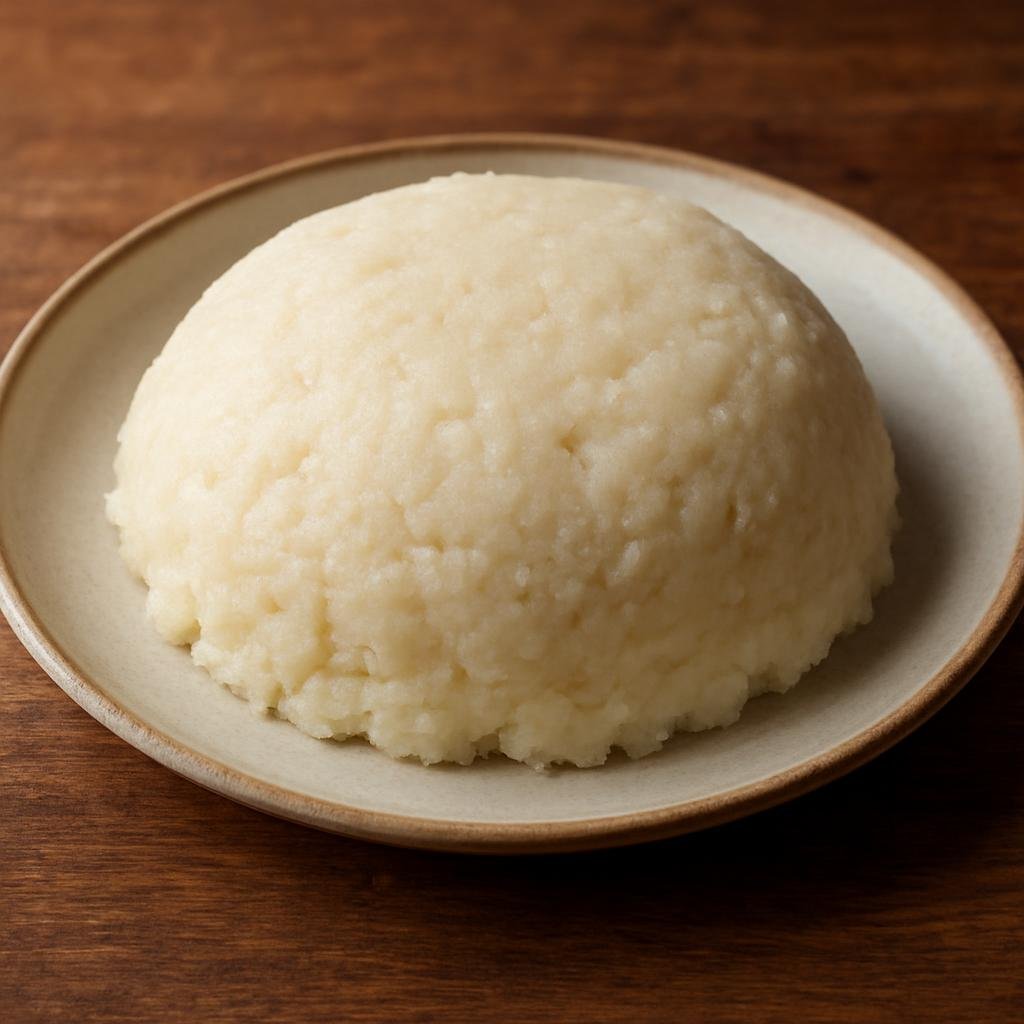
Serving Size: 4
Approximate Time
Prep
10 min
Cook
10 min
Additional
2 min
Total
22 min
Ingredients
- 4 cups (960 ml) water
- 1 tsp (6 g) salt
- 1 1/2 cups (195 g) fine maize meal (cornmeal/ugali flour)
- 1 tbsp (14 g) unsalted butter or 1 tbsp (15 ml) vegetable oil (optional, for sheen)
- Extra water for rinsing or adjusting consistency (if needed)
Instructions
1. Bring 4 cups (960 ml) water and 1 tsp (6 g) salt to a rolling boil in a heavy saucepan over medium-high heat.
2. Reduce heat to medium-low. Gradually sprinkle in 1 1/2 cups (195 g) maize meal in a steady stream while stirring continuously with a sturdy wooden spoon or whisk to prevent lumps.
3. Once all the meal is incorporated and the mixture thickens, cover the pot and let cook 1–2 minutes to allow the maize to absorb moisture.
4. Uncover and vigorously stir and fold the mixture with the spoon, pressing and turning the ugali against the side of the pot; it will become very stiff and pull away from the sides. If the mixture is too dry or too stiff to stir, add 1–2 tbsp (15–30 ml) hot water at a time to adjust.
5. Continue to cook and vigorously stir for 4–6 minutes until the ugali forms a smooth, dense mass with no raw flour taste. Stirring and pressing helps eliminate lumps and cooks the interior.
6. Remove from heat, add 1 tbsp (14 g) butter or 1 tbsp (15 ml) oil if using, and knead briefly inside the pot with the spoon to incorporate and smooth the surface.
7. Turn the ugali onto a plate or wooden board, shape into a round loaf using the spoon or a wet spatula, and let rest 1–2 minutes. Serve hot, tearing pieces by hand and using them to scoop stews, greens, or sauces.
Estimated Nutritional Information*
Per serving | Servings: 4
Calories: 202 kcal
Carbohydrates: 37.5 g
Protein: 4 g
Fat: 4.6 g
Saturated fat: 2 g
Cholesterol: 8 mg
Fiber: 3.6 g
Sugar: 0.3 g
Sodium: 608 mg
Potassium: 141 mg
Calcium: 11 mg
Iron: 1.69 mg
Vitamin A: 29 µg RAE
Generated: 2026-11-05T21:52:44+00:00
*Values are estimates based on USDA data and mathematical calculations. Actual values may vary. Where data are unavailable, those contributions are excluded. Calories, Carbohydrates, Protein, Fat, Saturated fat, Cholesterol, Fiber, Sugar, Sodium, Potassium, Calcium, Iron and Vitamin A are known subtotals. Missing contributions are unknown, not zero.