Entree: Poland – Greater Poland – Zrazy Wielkopolskie (Thin rolled beef roulades from Greater Poland filled with bacon, pickles, and onions, braised in a savory gravy)
Food safety reminder: Follow safe food-handling practices and use a food thermometer to verify safe internal cooking temperatures.
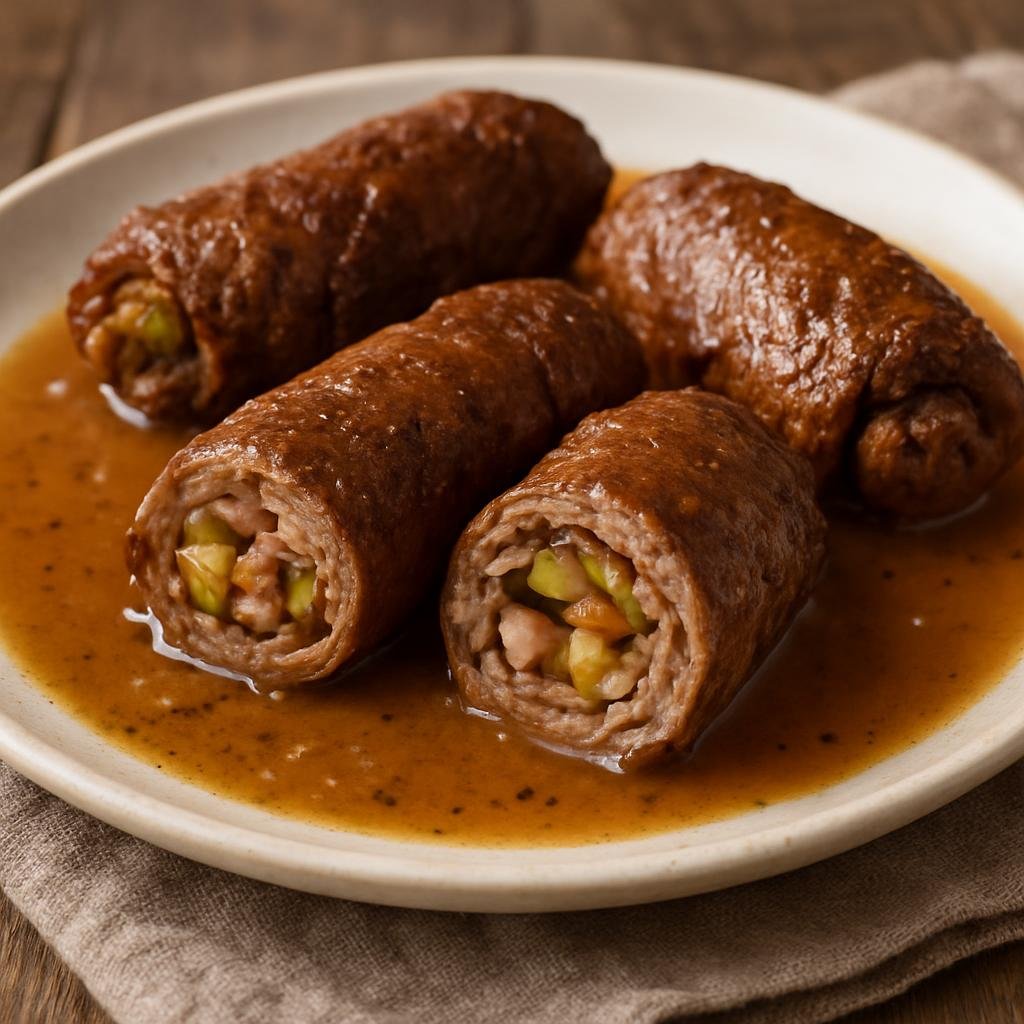
Serving Size: 4
Approximate Time
Prep
30 min
Cook
1 hr 10 min
Total
1 hr 40 min
Ingredients
- 8 thin beef slices (top round), approx. 24 oz (680 g) total
- 4 oz (115 g) bacon, diced
- 4 small pickles, about 4 oz (115 g) total, sliced lengthwise
- 1 medium onion, about 6 oz (170 g), finely chopped
- 2 tbsp (30 ml) Dijon mustard
- Salt and freshly ground black pepper to taste
- 2 tbsp (30 ml) vegetable oil
- 2 tbsp (28 g) butter
- 2 tbsp (16 g) all-purpose flour
- 2 cups (480 ml) beef broth
- 1 bay leaf
- 1 tsp (5 ml) marjoram or dried thyme
- 1 tbsp (15 ml) red wine vinegar or to taste
- 2 tbsp (30 ml) sour cream (optional, for finishing)
Instructions
U.S. measurements first, metric equivalents in parentheses. Conversions are approximate.
1. Pat the beef slices dry and, if needed, pound lightly to about 1/8–1/4 inch (0.318 to 0.635 cm) thickness; season both sides with salt and pepper and spread about 1/2 tsp (2.5 ml) Dijon mustard on each slice.
2. In a skillet over medium heat, cook the diced bacon until just crisp; remove with a slotted spoon and set aside, reserving 1 tbsp (15 ml) bacon fat in the pan.
3. Add 1 tbsp (15 ml) butter to the pan and sauté the chopped onion until soft and translucent, about 5–7 minutes; stir in the cooked bacon and remove from heat to cool slightly.
4. Place a few slices of pickle along one edge of each beef slice and spoon a portion of the bacon-onion mixture on top; roll the beef tightly and secure with kitchen twine or toothpicks.
5. Heat the vegetable oil and remaining 1 tbsp (15 ml) butter in a large ovenproof skillet or sauté pan over medium-high heat; brown the roulades on all sides until deeply colored, about 2–3 minutes per side.
6. Sprinkle the flour over the browned roulades and cook 1 minute to remove the raw flour taste; slowly add the beef broth while stirring to make a smooth sauce.
7. Add the bay leaf and marjoram, bring to a gentle simmer, cover, and braise on low heat for 45–60 minutes until the meat is tender (or place in a 325°F / 160°C oven covered for the same time).
8. Remove roulades to a plate and keep warm; skim any excess fat from the sauce and if desired stir in the red wine vinegar and sour cream for a rounded finish; adjust seasoning with salt and pepper.
9. Slice roulades crosswise or serve whole, spoon the gravy over, and serve with mashed potatoes, kluski, or braised cabbage.
Show original instructions
1. Pat the beef slices dry and, if needed, pound lightly to about 1/8–1/4 inch thickness; season both sides with salt and pepper and spread about 1/2 tsp Dijon mustard on each slice.
2. In a skillet over medium heat, cook the diced bacon until just crisp; remove with a slotted spoon and set aside, reserving 1 tbsp bacon fat in the pan.
3. Add 1 tbsp butter to the pan and sauté the chopped onion until soft and translucent, about 5–7 minutes; stir in the cooked bacon and remove from heat to cool slightly.
4. Place a few slices of pickle along one edge of each beef slice and spoon a portion of the bacon-onion mixture on top; roll the beef tightly and secure with kitchen twine or toothpicks.
5. Heat the vegetable oil and remaining 1 tbsp butter in a large ovenproof skillet or sauté pan over medium-high heat; brown the roulades on all sides until deeply colored, about 2–3 minutes per side.
6. Sprinkle the flour over the browned roulades and cook 1 minute to remove the raw flour taste; slowly add the beef broth while stirring to make a smooth sauce.
7. Add the bay leaf and marjoram, bring to a gentle simmer, cover, and braise on low heat for 45–60 minutes until the meat is tender (or place in a 325°F / 160°C oven covered for the same time).
8. Remove roulades to a plate and keep warm; skim any excess fat from the sauce and if desired stir in the red wine vinegar and sour cream for a rounded finish; adjust seasoning with salt and pepper.
9. Slice roulades crosswise or serve whole, spoon the gravy over, and serve with mashed potatoes, kluski, or braised cabbage.
Estimated Nutritional Information*
Per serving | Servings: 4
Calories: 559 kcal
Carbohydrates: 8.3 g
Protein: 43.1 g
Fat: 38.3 g
Saturated fat: 14.3 g
Fiber: 1.2 g
Sodium: 765 mg
Potassium: 749 mg
Calcium: 71 mg
Iron: 4.03 mg
Vitamin A: 60 µg RAE
Vitamin C: 3.4 mg
Generated: 2026-11-06T05:27:06+00:00
*Values are estimates based on USDA data and mathematical calculations. Actual values may vary. Where data are unavailable, those contributions are excluded. Calories, Carbohydrates, Protein, Fat, Saturated fat, Fiber, Sodium, Potassium, Calcium, Iron, Vitamin A and Vitamin C are known subtotals. Missing contributions are unknown, not zero.