Entree: French Southern Territories – Central Culinary Region – Boeuf en Croûte (Beef tenderloin wrapped in pastry with mushroom duxelles and prosciutto)
Food safety reminder: Follow safe food-handling practices and use a food thermometer to verify safe internal cooking temperatures.
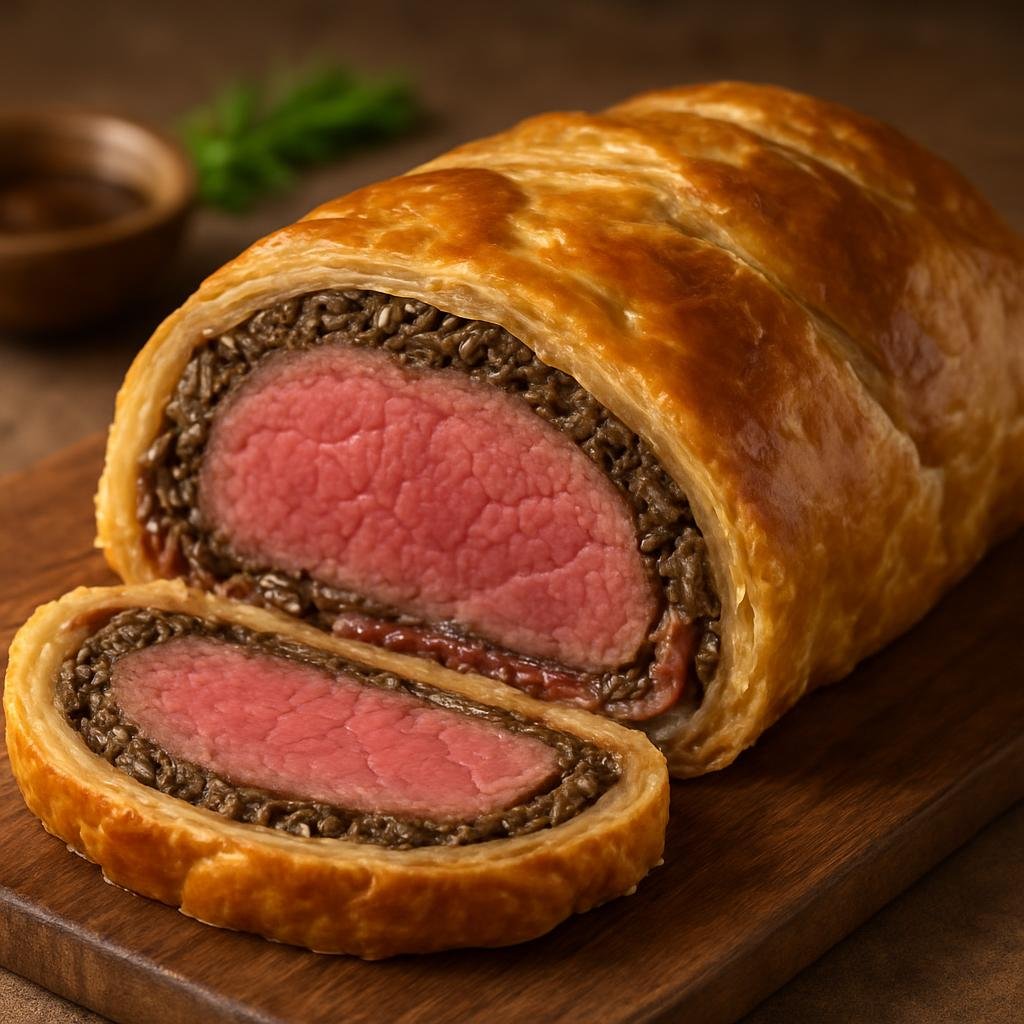
Serving Size: 4
Approximate Time
Prep
40 min
Cook
45 min
Additional
45 min
Total
2 hrs
Ingredients
U.S. measurements first, metric equivalents in parentheses. Conversions are approximate; oz means weight ounces, not fluid ounces.
- 2 lb (900 g) center-cut beef tenderloin, trimmed
- 1 1/2 tsp (8 g) kosher salt
- 1 tsp (2 g) freshly ground black pepper
- 2 tbsp (30 ml) olive oil
- 8 oz (225 g) cremini or button mushrooms, finely chopped
- 2 tbsp (30 g) unsalted butter
- 2 shallots, minced, approx. 2 oz (60 g)
- 2 cloves garlic, minced, approx. 0.21 oz (6 g)
- 1 tbsp (15 ml) dry white wine or dry sherry
- 8 slices prosciutto, approx. 4 oz (115 g)
- 2 tbsp (30 g) liver or country pâté (optional)
- 1 sheet puff pastry, thawed, about 14 oz (400 g)
- 2 large eggs, beaten, approx. 3.5 oz (100 g) total (for egg wash)
- 2 tsp (10 g) Dijon mustard
- 1 tbsp (8 g) all-purpose flour for dusting
- 1 tsp (1 g) fresh thyme leaves, chopped
- 1 small lemon, zested (optional, about 1 tsp (2 g))
Show original ingredient measurements
- 2 lb (900 g) center-cut beef tenderloin, trimmed
- 1 1/2 tsp (8 g) kosher salt
- 1 tsp (2 g) freshly ground black pepper
- 2 tbsp (30 ml) olive oil
- 8 oz (225 g) cremini or button mushrooms, finely chopped
- 2 tbsp (30 g) unsalted butter
- 2 shallots, minced, approx. 2 oz (60 g)
- 2 cloves garlic, minced, approx. 6 g
- 1 tbsp (15 ml) dry white wine or dry sherry
- 8 slices prosciutto, approx. 4 oz (115 g)
- 2 tbsp (30 g) liver or country pâté (optional)
- 1 sheet puff pastry, thawed, about 14 oz (400 g)
- 2 large eggs, beaten, approx. 3.5 oz (100 g) total (for egg wash)
- 2 tsp (10 g) Dijon mustard
- 1 tbsp (8 g) all-purpose flour for dusting
- 1 tsp (1 g) fresh thyme leaves, chopped
- 1 small lemon, zested (optional, about 1 tsp / 2 g)
Instructions
1. Preheat the oven to 425°F (220°C). Season the tenderloin on all sides with 1 tsp (5 g) of the salt and 1/2 tsp (1 g) of the pepper. Heat 2 tbsp (30 ml) olive oil in a large skillet over high heat until shimmering. Sear the tenderloin on all sides until well browned, about 2 minutes per side. Transfer to a plate and let cool slightly; brush all over with 2 tsp (10 g) Dijon mustard.
2. In the same skillet, reduce heat to medium and add 2 tbsp (30 g) butter. Add minced shallots and garlic and cook until softened, about 2 minutes. Add the chopped mushrooms and cook, stirring, until they release their moisture and it evaporates, about 8–10 minutes. Stir in 1 tbsp (15 ml) white wine and cook until absorbed. Season with remaining 1/2 tsp (3 g) salt, 1/2 tsp (1 g) pepper, and 1 tsp (1 g) thyme. Cool the duxelles completely.
3. On a lightly floured surface, lay out a sheet of plastic wrap. Arrange the prosciutto slices in an overlapping layer to form a rectangle slightly longer than the tenderloin. Spread the cooled mushroom duxelles evenly over the prosciutto and, if using, dot 2 tbsp (30 g) pâté across the duxelles. Place the mustard-coated tenderloin on the duxelles and, using the plastic wrap, roll the prosciutto and duxelles tightly around the beef into a log. Twist ends of the plastic wrap and chill in the refrigerator for 20–30 minutes to firm.
4. Roll the puff pastry on a lightly floured surface to a rectangle large enough to encase the beef. Unwrap the prosciutto-wrapped tenderloin and place it in the center of the pastry. Brush pastry edges with beaten egg. Wrap the pastry around the beef, sealing seams and trimming excess. Place seam-side down on a parchment-lined baking sheet. Brush the pastry all over with egg wash and use any trimmings to decorate. Chill 15 minutes to set.
5. Bake at 425°F (220°C) for 20 minutes, then reduce oven temperature to 375°F (190°C) and bake until pastry is deep golden and a meat thermometer reads 125–130°F (52–54°C) for medium-rare, about 10–15 more minutes depending on thickness. Let rest 10–15 minutes before slicing. Serve sliced with pan sauce, a simple red wine jus, or roasted vegetables.
Estimated Nutritional Information*
Per serving | Servings: 4
Calories: 800 kcal
Carbohydrates: 7.3 g
Protein: 57.9 g
Fat: 58.8 g
Saturated fat: 25.3 g
Cholesterol: 321 mg
Fiber: 1.4 g
Sodium: 1732 mg
Potassium: 1115 mg
Calcium: 86 mg
Iron: 4.72 mg
Vitamin A: 92 µg RAE
Vitamin C: 3.5 mg
Nutrition estimated: November 6, 2026
*Values are estimates based on USDA data and mathematical calculations. Actual values may vary. Where data are unavailable, those contributions are excluded. Calories, Carbohydrates, Protein, Fat, Saturated fat, Cholesterol, Fiber, Sodium, Potassium, Calcium, Iron, Vitamin A and Vitamin C are known subtotals. Missing contributions are unknown, not zero.