Entree: North Korea – North Korean Mountain Cuisine – 보쌈 ➤ bossam (Simmered seasoned pork belly served thinly sliced with leafy wraps and condiments)
Food safety reminder: Follow safe food-handling practices and use a food thermometer to verify safe internal cooking temperatures.
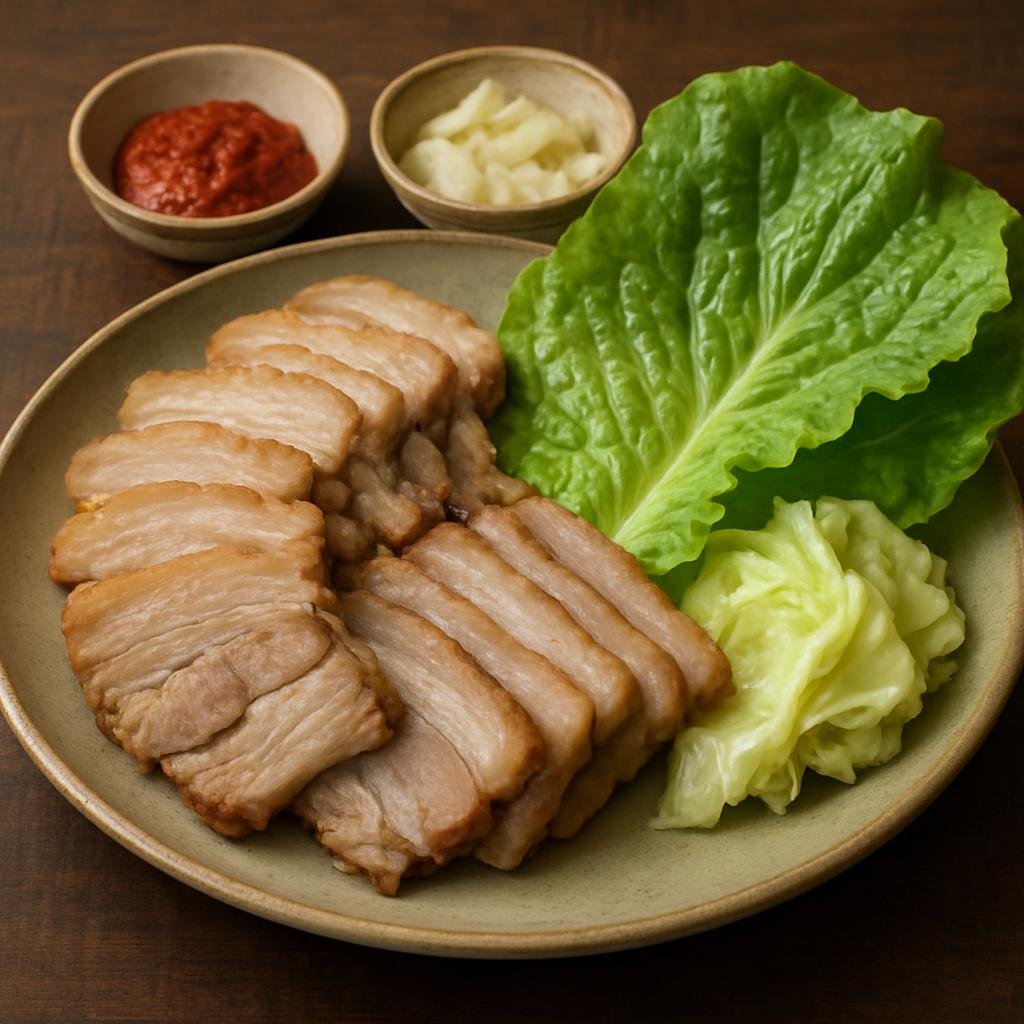
Serving Size: 4
Approximate Time
Prep
20 min
Cook
1 hr 15 min
Additional
10 min
Total
1 hr 50 min
Ingredients
- 3 lb (1.36 kg) pork belly, skin on
- 8 cups (1.9 L) water (or enough to cover pork)
- 1 large onion, halved, approx. 8 oz (225 g)
- 8 cloves garlic, crushed, approx. 1.4 oz (40 g)
- 2 in (5 cm) piece fresh ginger, sliced, approx. 0.9 oz (25 g)
- 1 4x4 in (10x10 cm) piece dried kelp (kombu)
- 1 tbsp (6 g) whole black peppercorns
- 4 stalks green onion (scallions), tied in a knot, approx. 4 oz (115 g)
- 2 tbsp (30 g) doenjang (fermented soybean paste)
- 1/4 cup (60 ml) light soy sauce
- 2 tbsp (30 ml) rice wine or mirin
- 1 tsp (5 g) kosher salt, plus more to taste
- 12 large napa cabbage leaves or butter lettuce leaves for wrapping
- 1 cup (240 g) baechu kimchi (firm kimchi), chopped for serving
- 4 cloves raw garlic, thinly sliced, approx. 0.7 oz (20 g) (for wraps)
- 1/4 cup (60 ml) saeujeot (salted fermented shrimp) or substitute lightly salted anchovy sauce (optional, for serving)
- For ssamjang dipping sauce: 3 tbsp (45 g) doenjang, 1 tbsp (15 g) gochujang, 1 tbsp (15 ml) sesame oil, 1 tsp (5 g) minced garlic, 1 tsp (5 g) sugar
- Optional garnishes: sliced green chili, perilla leaves, steamed rice for serving
Instructions
U.S. measurements first, metric equivalents in parentheses. Conversions are approximate.
1. Prepare the pork: Rinse pork belly and trim any excessive soft fat if desired. Place pork in a large stockpot and add 8 cups (1.9 L) water to cover the meat.
2. Add aromatics and seasonings: Add halved onion, crushed garlic, sliced ginger, kelp piece, whole black peppercorns, tied green onions, 2 tbsp (30 g) doenjang, 1/4 cup (60 ml) soy sauce, and 2 tbsp (30 ml) rice wine to the pot.
3. Bring to a boil and skim: Bring to a rolling boil over high heat. Once boiling, lower heat to maintain a gentle simmer and skim off any foam or scum that rises to the surface for the first 10 minutes.
4. Simmer until tender: Cover partially and simmer gently for 1 to 1 1/4 hours, or until the pork belly is very tender but still sliceable. Remove kelp after 20 minutes to avoid bitterness, leaving the rest of the aromatics.
5. Cool slightly and slice: Transfer pork to a cutting board and let rest 10 minutes. Slice pork belly into thin, bite-sized slices approximately 1/8–1/4 inch (0.318 to 0.635 cm) thick.
6. Make ssamjang: In a small bowl combine 3 tbsp (45 g) doenjang, 1 tbsp (15 g) gochujang, 1 tbsp (15 ml) sesame oil, 1 tsp (5 g) minced garlic, and 1 tsp (5 g) sugar; stir until smooth. Adjust seasoning to taste.
7. Warm and prepare wraps: Briefly blanch or steam napa cabbage leaves 10–20 seconds if using cabbage so they are pliable, or use fresh lettuce/perilla leaves. Arrange leaves, sliced pork, kimchi, raw garlic slices, ssamjang, and saeujeot on a platter.
8. Serve: To eat, place a slice of pork on a leaf, add a small spoonful of kimchi, a dab of ssamjang, a slice of raw garlic or a bit of saeujeot, wrap and eat. Serve with steamed rice and extra kimchi.
Show original instructions
1. Prepare the pork: Rinse pork belly and trim any excessive soft fat if desired. Place pork in a large stockpot and add 8 cups (1.9 L) water to cover the meat.
2. Add aromatics and seasonings: Add halved onion, crushed garlic, sliced ginger, kelp piece, whole black peppercorns, tied green onions, 2 tbsp (30 g) doenjang, 1/4 cup (60 ml) soy sauce, and 2 tbsp (30 ml) rice wine to the pot.
3. Bring to a boil and skim: Bring to a rolling boil over high heat. Once boiling, lower heat to maintain a gentle simmer and skim off any foam or scum that rises to the surface for the first 10 minutes.
4. Simmer until tender: Cover partially and simmer gently for 1 to 1 1/4 hours, or until the pork belly is very tender but still sliceable. Remove kelp after 20 minutes to avoid bitterness, leaving the rest of the aromatics.
5. Cool slightly and slice: Transfer pork to a cutting board and let rest 10 minutes. Slice pork belly into thin, bite-sized slices approximately 1/8–1/4 inch thick.
6. Make ssamjang: In a small bowl combine 3 tbsp (45 g) doenjang, 1 tbsp (15 g) gochujang, 1 tbsp (15 ml) sesame oil, 1 tsp (5 g) minced garlic, and 1 tsp (5 g) sugar; stir until smooth. Adjust seasoning to taste.
7. Warm and prepare wraps: Briefly blanch or steam napa cabbage leaves 10–20 seconds if using cabbage so they are pliable, or use fresh lettuce/perilla leaves. Arrange leaves, sliced pork, kimchi, raw garlic slices, ssamjang, and saeujeot on a platter.
8. Serve: To eat, place a slice of pork on a leaf, add a small spoonful of kimchi, a dab of ssamjang, a slice of raw garlic or a bit of saeujeot, wrap and eat. Serve with steamed rice and extra kimchi.
Estimated Nutritional Information*
Per serving | Servings: 4
Calories: 1886 kcal
Carbohydrates: 26.9 g
Protein: 35.9 g
Fat: 180.9 g
Sugar: 9.4 g
Sodium: 1708 mg
Generated: 2026-11-05T19:44:48+00:00
*Values are estimates based on USDA data and mathematical calculations. Actual values may vary. Where data are unavailable, those contributions are excluded. Calories, Carbohydrates, Protein, Fat, Sugar and Sodium are known subtotals. Missing contributions are unknown, not zero.