Entree: Costa Rica – Northern Culinary Region – Tamales (Corn dough parcels filled with seasoned pork and vegetables, wrapped in banana leaves and steamed)
Food safety reminder: Follow safe food-handling practices and use a food thermometer to verify safe internal cooking temperatures.
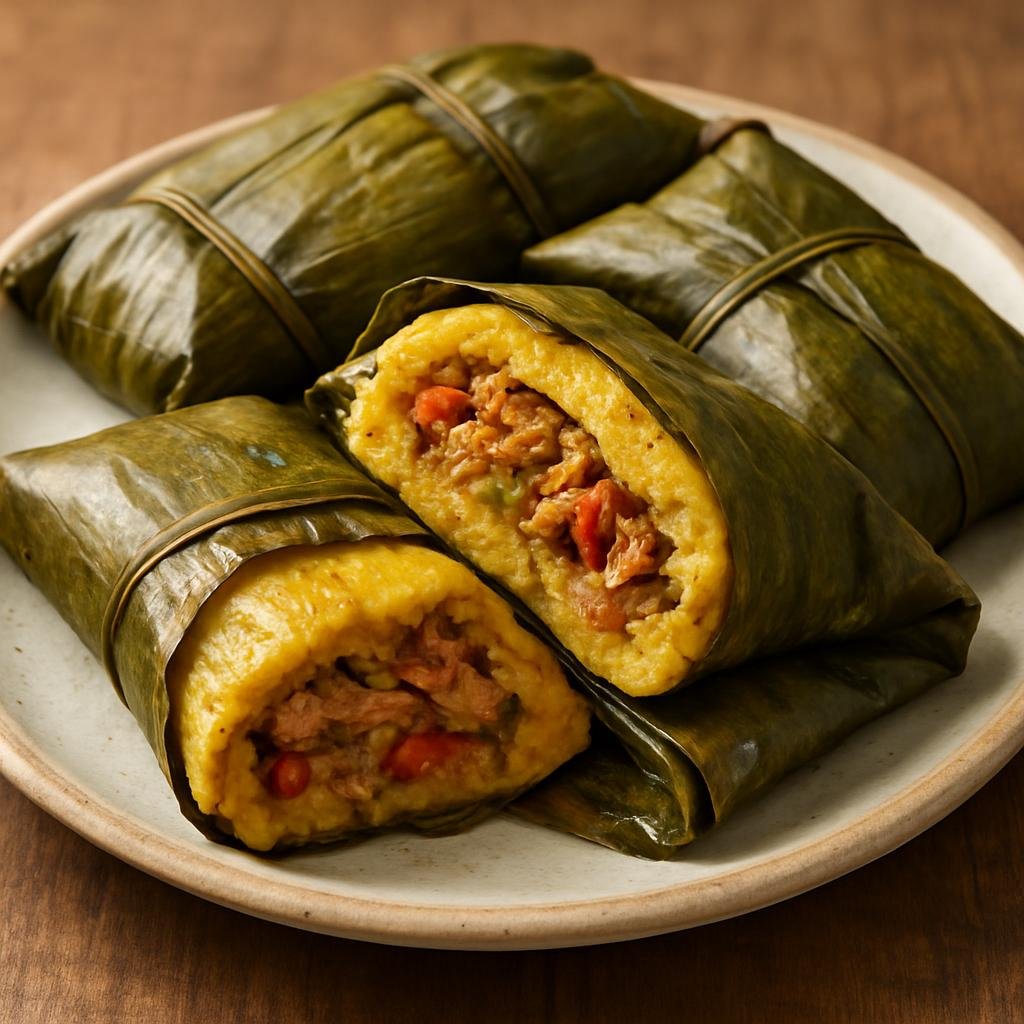
Serving Size: 6
Approximate Time
Prep
40 min
Cook
2 hrs
Additional
10 min
Total
2 hrs 45 min
Ingredients
U.S. measurements first, metric equivalents in parentheses. Conversions are approximate; oz means weight ounces, not fluid ounces.
- 4 cups (480 g) masa harina
- 3 to 3 1/2 cups (720 to 840 ml) chicken or pork broth, warm
- 1 cup (240 g) lard or vegetable shortening
- 1 tbsp (15 ml) annatto oil (achote oil) or 1 tsp (2 g) achiote powder dissolved in 1 tbsp (15 ml) oil
- 1 1/2 tsp (9 g) kosher salt, plus more to taste
- 1 tsp (4 g) ground black pepper
- 1 1/2 lb (680 g) pork shoulder, cut into 1-inch (2.54 cm) pieces, trimmed of excess fat
- 1 cup (240 ml) orange juice (preferably fresh) or 1/2 cup (120 ml) orange juice + 1/2 cup (120 ml) water for braising
- 1 large onion, diced (about 1 cup (150 g))
- 1 red bell pepper, diced (about 1 cup (150 g))
- 2 medium carrots, peeled and diced (about 1 cup (130 g))
- 1 cup (185 g) cooked white rice
- 1/2 cup (75 g) frozen peas
- 2 cloves garlic, minced (about 0.21 oz (6 g))
- 1 tbsp (15 ml) Worcestershire sauce or 1 tbsp (15 ml) soy sauce
- 1 tsp (2 g) ground cumin
- 1/2 tsp (2 g) ground allspice
- 8 to 10 banana leaves, cleaned and softened over heat, cut to 10x12 inch pieces (no measurement required if using parchment for assembly)
- Kitchen twine for tying
Show original ingredient measurements
- 4 cups (480 g) masa harina
- 3 to 3 1/2 cups (720 to 840 ml) chicken or pork broth, warm
- 1 cup (240 g) lard or vegetable shortening
- 1 tbsp (15 ml) annatto oil (achote oil) or 1 tsp (2 g) achiote powder dissolved in 1 tbsp (15 ml) oil
- 1 1/2 tsp (9 g) kosher salt, plus more to taste
- 1 tsp (4 g) ground black pepper
- 1 1/2 lb (680 g) pork shoulder, cut into 1-inch pieces, trimmed of excess fat
- 1 cup (240 ml) orange juice (preferably fresh) or 1/2 cup (120 ml) orange juice + 1/2 cup (120 ml) water for braising
- 1 large onion, diced (about 1 cup / 150 g)
- 1 red bell pepper, diced (about 1 cup / 150 g)
- 2 medium carrots, peeled and diced (about 1 cup / 130 g)
- 1 cup (185 g) cooked white rice
- 1/2 cup (75 g) frozen peas
- 2 cloves garlic, minced (about 6 g)
- 1 tbsp (15 ml) Worcestershire sauce or 1 tbsp (15 ml) soy sauce
- 1 tsp (2 g) ground cumin
- 1/2 tsp (2 g) ground allspice
- 8 to 10 banana leaves, cleaned and softened over heat, cut to 10x12 inch pieces (no measurement required if using parchment for assembly)
- Kitchen twine for tying
Instructions
U.S. measurements first, metric equivalents in parentheses. Conversions are approximate.
1. Season the pork pieces with 1 tsp (5 ml) salt, 1/2 tsp (2.5 ml) pepper, cumin and allspice. In a heavy pot, brown the pork in 1 tbsp (15 ml) oil over medium-high heat, then add the diced onion, garlic and bell pepper and cook until softened, about 5 minutes.
2. Add the orange juice, Worcestershire sauce, 1/2 cup (120 ml) broth and 1/2 tsp (2.5 ml) salt. Bring to a simmer, cover and braise gently until pork is tender, about 1 to 1 1/4 hours. Once cooked, shred or chop the pork into bite-sized pieces and reserve 1/2 cup (120 ml) of the braising liquid.
3. Prepare the masa: in a large bowl, mix masa harina with remaining warm broth, lard, annatto oil and remaining salt and pepper. Beat or mix until the dough is soft, spreadable and slightly airy — it should hold together but be spreadable (adjust with up to 1/4 cup (60 ml) more broth if needed).
4. Fold the cooked rice, carrots, peas and 1 cup (240 g) of the shredded pork into the masa, adding a couple tablespoons of reserved braising liquid for flavor and moisture. Taste and adjust seasoning.
5. To assemble, place a 1/3 to 1/2 cup (80 to 120 g) of masa mixture in the center of each banana leaf square, flatten slightly, add 1 to 2 tbsp (15 to 30 g) of shredded pork, then top with a little more masa to enclose the filling. Fold the banana leaf over to make a tidy packet and tie with kitchen twine. If using parchment, wrap twice and tie.
6. Arrange tamales upright in a large steamer or a tall pot with a rack and enough simmering water to reach just below the tamales. Steam gently for 1 1/2 to 2 hours, checking water level occasionally and topping with hot water as needed.
7. Remove tamales and let rest 10 minutes before unwrapping. Serve hot with pickled vegetables or a lightly spiced salsa.
Show original instructions
1. Season the pork pieces with 1 tsp salt, 1/2 tsp pepper, cumin and allspice. In a heavy pot, brown the pork in 1 tbsp (15 ml) oil over medium-high heat, then add the diced onion, garlic and bell pepper and cook until softened, about 5 minutes.
2. Add the orange juice, Worcestershire sauce, 1/2 cup (120 ml) broth and 1/2 tsp salt. Bring to a simmer, cover and braise gently until pork is tender, about 1 to 1 1/4 hours. Once cooked, shred or chop the pork into bite-sized pieces and reserve 1/2 cup (120 ml) of the braising liquid.
3. Prepare the masa: in a large bowl, mix masa harina with remaining warm broth, lard, annatto oil and remaining salt and pepper. Beat or mix until the dough is soft, spreadable and slightly airy — it should hold together but be spreadable (adjust with up to 1/4 cup / 60 ml more broth if needed).
4. Fold the cooked rice, carrots, peas and 1 cup (240 g) of the shredded pork into the masa, adding a couple tablespoons of reserved braising liquid for flavor and moisture. Taste and adjust seasoning.
5. To assemble, place a 1/3 to 1/2 cup (80 to 120 g) of masa mixture in the center of each banana leaf square, flatten slightly, add 1 to 2 tbsp (15 to 30 g) of shredded pork, then top with a little more masa to enclose the filling. Fold the banana leaf over to make a tidy packet and tie with kitchen twine. If using parchment, wrap twice and tie.
6. Arrange tamales upright in a large steamer or a tall pot with a rack and enough simmering water to reach just below the tamales. Steam gently for 1 1/2 to 2 hours, checking water level occasionally and topping with hot water as needed.
7. Remove tamales and let rest 10 minutes before unwrapping. Serve hot with pickled vegetables or a lightly spiced salsa.
Estimated Nutritional Information*
Per serving | Servings: 6
Calories: 1048 kcal
Carbohydrates: 84.2 g
Protein: 31.1 g
Fat: 65.5 g
Fiber: 8.3 g
Sodium: 1168 mg
Potassium: 1004 mg
Calcium: 151 mg
Iron: 4.2 mg
Generated: 2026-11-05T19:47:44+00:00
*Values are estimates based on USDA data and mathematical calculations. Actual values may vary. Where data are unavailable, those contributions are excluded. Calories, Carbohydrates, Protein, Fat, Fiber, Sodium, Potassium, Calcium and Iron are known subtotals. Missing contributions are unknown, not zero.