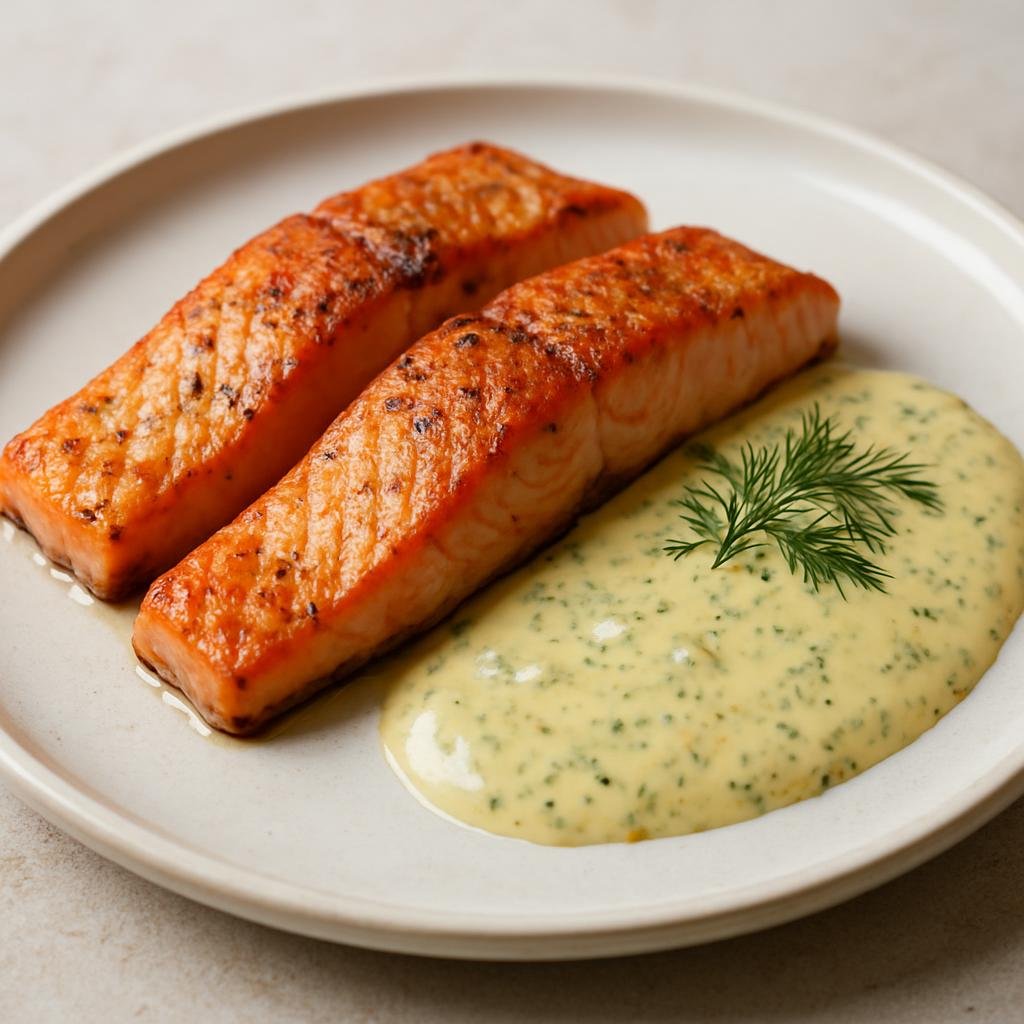
Entree: Norway – Oslo & Eastern Norway – Stekt Laks (Pan-seared salmon fillets seasoned simply and served with a creamy dill mustard sauce)
Food safety reminder: Follow safe food-handling practices and use a food thermometer to verify safe internal cooking temperatures.
Serving Size: 4
Approximate Time
Prep
15 min
Cook
18 min
Additional
2 min
Total
35 min
Ingredients
- 4 salmon fillets, approx. 6 oz (170 g) each, skin-on
- 1 1/2 lb (680 g) new potatoes or small waxy potatoes
- 2 tbsp (16 g) all-purpose flour for dusting
- 2 tbsp (28 g) unsalted butter
- 1 tbsp (15 ml) olive oil
- 1 tsp (5 ml) coarse sea salt, plus more to taste
- 1/2 tsp (2.5 ml) freshly ground black pepper
- 1/2 cup (120 ml) sour cream or crème fraîche
- 1 tbsp (15 ml) Dijon mustard
- 1 tbsp (15 ml) fresh lemon juice
- 2 tbsp (8 g) fresh dill, chopped, plus extra for garnish
- Lemon wedges for serving
Instructions
1. Place potatoes in a saucepan, cover with cold salted water, bring to a boil and cook until tender, 12–15 minutes depending on size. Drain and keep warm.
2. While potatoes cook, mix sour cream, Dijon mustard, lemon juice, and chopped dill in a small bowl; season with a pinch of salt and pepper. Chill until serving.
3. Pat salmon fillets dry with paper towels and season both sides with 1 tsp (5 ml) sea salt and 1/2 tsp (2.5 ml) black pepper. Lightly dust the flesh-side with 2 tbsp (16 g) flour, shaking off excess.
4. Heat a large skillet over medium-high heat and add 1 tbsp (15 ml) olive oil and 2 tbsp (28 g) unsalted butter. When the butter foams and is just beginning to brown, place fillets skin-side down and press gently for 15 seconds to prevent curling.
5. Cook skin-side down until skin is crisp and the fish is cooked about two-thirds of the way through, 4–5 minutes depending on thickness. Flip and cook flesh-side 1–2 minutes more until just cooked through (internal temperature about 125–130°F / 52–54°C for medium).
6. Remove salmon to a warm plate and rest 1–2 minutes. If desired, squeeze a little lemon over fillets.
7. Serve the stekt laks with boiled potatoes, a generous spoonful of dill-mustard cream sauce, extra dill, and lemon wedges.
Estimated Nutritional Information*
Per serving | Servings: 4
Calories: 641 kcal
Carbohydrates: 34.9 g
Protein: 39.6 g
Fat: 37.8 g
Saturated fat: 12.2 g
Cholesterol: 126 mg
Fiber: 4 g
Sodium: 746 mg
Potassium: 1410 mg
Calcium: 76 mg
Iron: 2.41 mg
Vitamin A: 190 µg RAE
Vitamin C: 43.6 mg
Vitamin D: 18.7 µg
Generated: 2026-11-05T19:48:21+00:00
*Values are estimates based on USDA data and mathematical calculations. Actual values may vary. Where data are unavailable, those contributions are excluded. Calories, Carbohydrates, Protein, Fat, Saturated fat, Cholesterol, Fiber, Sodium, Potassium, Calcium, Iron, Vitamin A, Vitamin C and Vitamin D are known subtotals. Missing contributions are unknown, not zero.