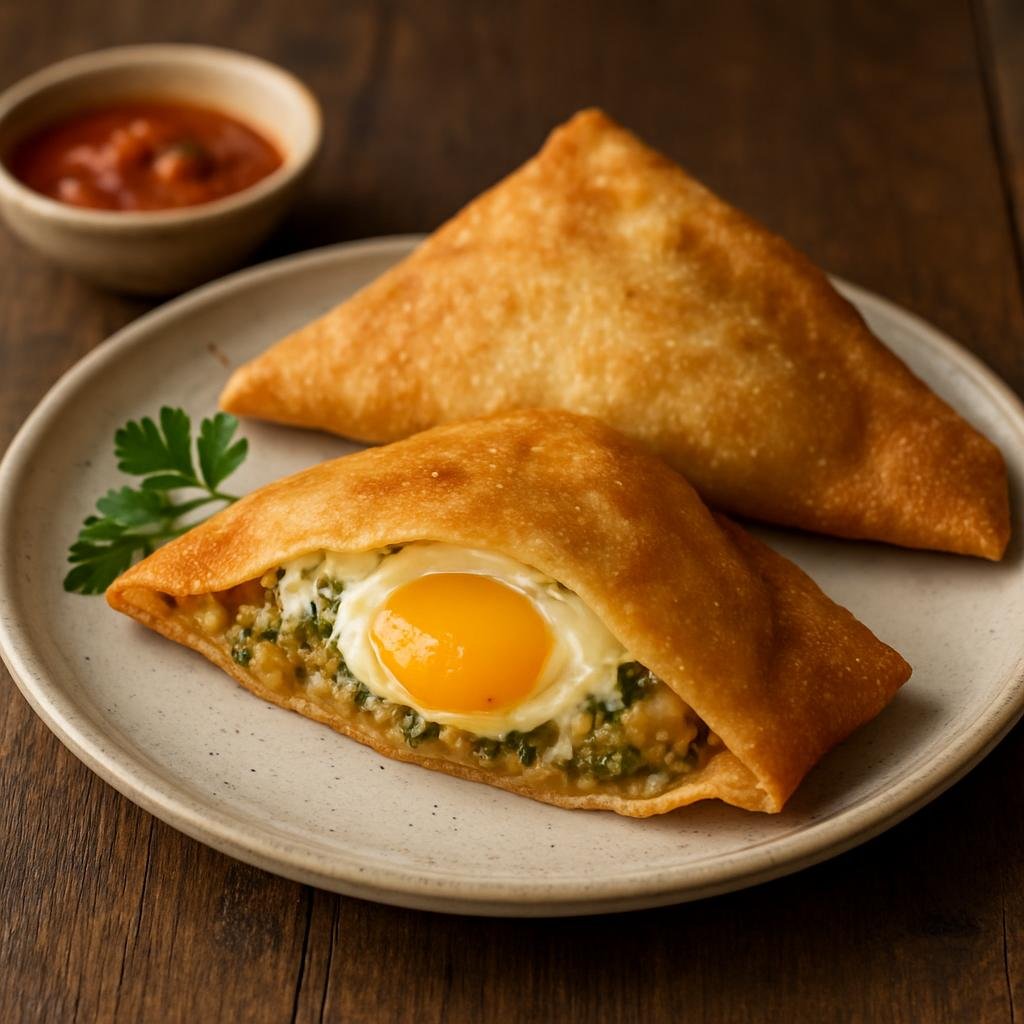
Entree: Tunisia – Tunis & North – بريك بالبيض ➤ Brīk bil-bayḍ (Crispy folded thin pastry filled with egg and savory ingredients)
Food safety reminder: Follow safe food-handling practices and use a food thermometer to verify safe internal cooking temperatures.
Serving Size: 4
Approximate Time
Prep
20 min
Cook
6 min
Total
26 min
Ingredients
- 4 sheets malsouka or phyllo dough (use 1 sheet per portion)
- 4 large eggs, approx. 1.8 oz (50 g) each
- 4 oz (115 g) canned tuna, drained and flaked
- 2 tbsp (30 g) capers, drained
- 2 tbsp (8 g) chopped flat-leaf parsley
- 1 tsp (5 g) harissa (adjust to taste)
- 1/2 tsp (3 g) kosher salt
- 1/4 tsp (1 g) freshly ground black pepper
- 2 tbsp (16 g) all-purpose flour
- 3 tbsp (45 ml) water (for sealing paste)
- 1/2 cup (120 ml) vegetable oil for shallow frying
- Lemon wedges for serving
Instructions
1. In a small bowl whisk the flour with 3 tbsp (45 ml) water to a smooth paste; keep nearby as sealing glue. Mix tuna, capers, parsley and harissa in another bowl; season with 1/4 tsp (1 g) salt and pepper.
2. Lay one sheet of malsouka/ phyllo on a work surface. Place about 1 tbsp (15 ml) of the tuna mixture toward the center. Make a small well and gently crack one egg into the center over the tuna; if the sheet is large, fold into a triangular parcel, or fold the edges over to enclose the filling, sealing edges with the flour paste.
3. Heat oil in a 10–12 inch (25–30 cm) skillet over medium-high heat until shimmering. Carefully slide one parcel into the hot oil, seam-side down. Fry 2–3 minutes until golden, then flip and fry another 2–3 minutes until crisp and the white is set but yolk remains slightly runny (cook a little longer for a firmer yolk).
4. Transfer to a paper towel-lined plate to drain. Repeat with remaining sheets and fillings, adding more oil if needed. Season with remaining 1/4 tsp (2 g) salt to taste.
5. Serve immediately with lemon wedges and extra harissa on the side.
Estimated Nutritional Information*
Per serving | Servings: 4
Calories: 330 kcal
Carbohydrates: 4.1 g
Protein: 7 g
Fat: 32.1 g
Saturated fat: 5.9 g
Cholesterol: 186 mg
Fiber: 0.5 g
Sugar: 0.2 g
Sodium: 539 mg
Potassium: 91 mg
Calcium: 36 mg
Iron: 1.35 mg
Vitamin A: 89 µg RAE
Vitamin C: 3 mg
Vitamin D: 1 µg
Generated: 2026-11-05T19:49:47+00:00
*Values are estimates based on USDA data and mathematical calculations. Actual values may vary. Where data are unavailable, those contributions are excluded. Calories, Carbohydrates, Protein, Fat, Saturated fat, Cholesterol, Fiber, Sugar, Sodium, Potassium, Calcium, Iron, Vitamin A, Vitamin C and Vitamin D are known subtotals. Missing contributions are unknown, not zero.