Entree: Switzerland – Italian Swiss / Ticino – Gnocchi di Castagne (Small dumplings made from chestnut purée and flour, typically served with butter and sage or grated cheese)
Food safety reminder: Follow safe food-handling practices and use a food thermometer to verify safe internal cooking temperatures.
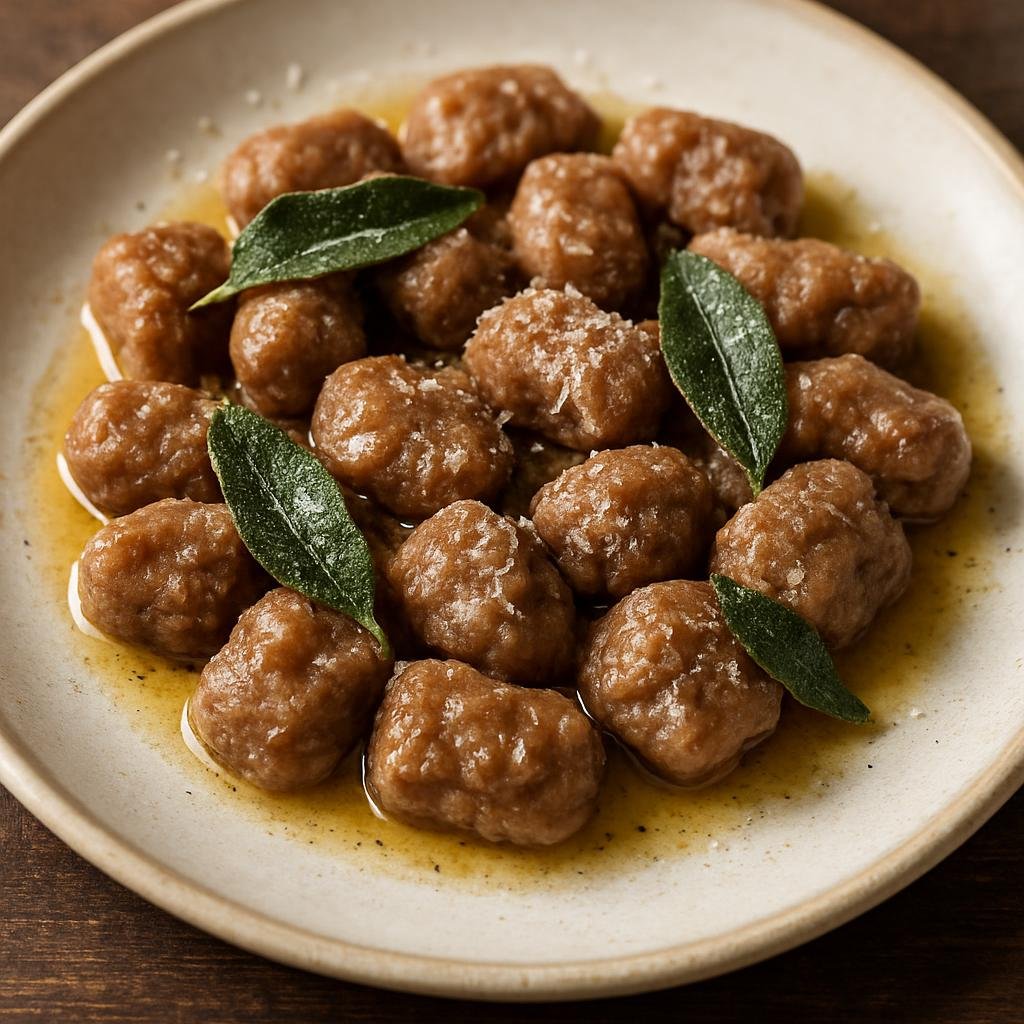
Serving Size: 4
Approximate Time
Prep
25 min
Cook
10 min
Total
35 min
Ingredients
- 1 1/4 cups (300 g) cooked chestnut purée (unsweetened)
- 1 cup (130 g) all-purpose flour, plus extra for dusting
- 1/4 cup (25 g) finely grated Parmigiano-Reggiano, plus more to serve
- 1 large egg, approx. 1.8 oz (50 g), lightly beaten
- 1/2 tsp (2.5 g) fine salt
- Pinch ground nutmeg
- 6 tbsp (85 g) unsalted butter
- 10–12 fresh sage leaves
- Coarse salt for boiling water
- Freshly grated Parmigiano-Reggiano, to serve
Instructions
1. In a large bowl, combine the chestnut purée, beaten egg, salt, and a pinch of nutmeg; mix until smooth.
2. Stir in the grated Parmigiano-Reggiano, then add the flour a little at a time, folding gently until a soft, slightly tacky dough forms. Avoid overworking; add up to 2–3 tbsp (20–40 g) more flour if the dough is too sticky.
3. Turn dough onto a floured surface and divide into 4 portions. Roll each portion into a 3/4-inch (2 cm) thick rope, dusting with flour as needed. Cut ropes into 3/4-inch (2 cm) pieces and, if desired, press each piece lightly with a fork to form ridges.
4. Bring a large pot of salted water to a gentle boil. Cook gnocchi in batches; when they float to the surface, cook 1–2 minutes more, then remove with a slotted spoon and transfer to a warm plate. Reserve 1/2 cup (120 ml) of the cooking water.
5. In a large skillet, melt the butter over medium heat until it foams and begins to brown slightly. Add the sage leaves and cook until fragrant and crisp, about 1 minute.
6. Add the cooked gnocchi to the skillet with a splash of reserved cooking water and toss gently in the butter-sage sauce to coat and warm through, 1–2 minutes. Serve immediately sprinkled with additional Parmigiano-Reggiano.
Estimated Nutritional Information*
Per serving | Servings: 4
Calories: 315 kcal
Carbohydrates: 25.8 g
Protein: 6.9 g
Fat: 20.5 g
Saturated fat: 12.1 g
Cholesterol: 98 mg
Fiber: 0.9 g
Sugar: 0.2 g
Sodium: 376 mg
Potassium: 69 mg
Calcium: 71 mg
Iron: 1.76 mg
Vitamin A: 182 µg RAE
Vitamin C: 0 mg
Vitamin D: 0.3 µg
Generated: 2026-11-05T19:51:26+00:00
*Values are estimates based on USDA data and mathematical calculations. Actual values may vary. Where data are unavailable, those contributions are excluded. Calories, Carbohydrates, Protein, Fat, Saturated fat, Cholesterol, Fiber, Sugar, Sodium, Potassium, Calcium, Iron, Vitamin A, Vitamin C and Vitamin D are known subtotals. Missing contributions are unknown, not zero.