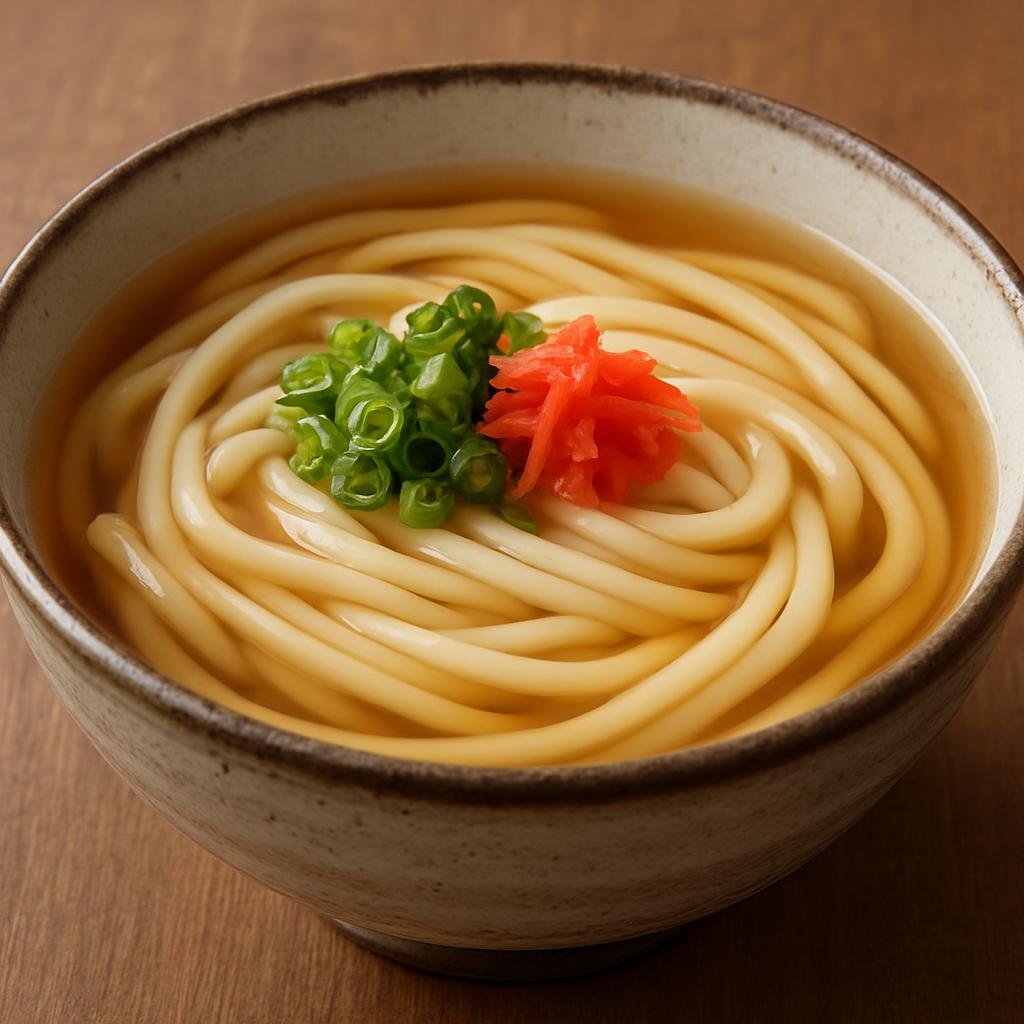
Entree: Japan – Kyushu – 博多うどん ➤ Hakata udon (Thick, soft wheat noodles served in a clear, umami-rich dashi broth typical of Fukuoka’s Hakata district)
Food safety reminder: Follow safe food-handling practices and use a food thermometer to verify safe internal cooking temperatures.
Ingredients
U.S. measurements first, metric equivalents in parentheses. Conversions are approximate; oz means weight ounces, not fluid ounces.
- 12 oz (340 g) fresh or frozen thick udon noodles (or 9–10 oz (255–285 g) dried, cooked per package)
- 6 cups (1.4 L) dashi stock (see below to make from kombu and katsuobushi)
- 1 piece (about 4x4 in / 10x10 cm) kombu (kelp)
- 1 cup (approx. 15 g) katsuobushi (bonito flakes)
- 3 tbsp (45 ml) light soy sauce
- 2 tbsp (30 ml) mirin
- 1 tbsp (15 ml) sake
- 1 tsp (5 g) salt, or to taste
- 8 oz (225 g) pork belly, thinly sliced
- 1 tbsp (15 ml) vegetable oil (for browning pork)
- 3 stalks (about 1 9/16 oz (45 g)) green onions, thinly sliced on the bias
- 1/2 cup (30 g) tenkasu (tempura bits)
- 4 oz (115 g) kamaboko or narutomaki, thinly sliced (optional)
- 1 tsp (5 ml) sesame oil (optional, for pork)
Show original ingredient measurements
- 12 oz (340 g) fresh or frozen thick udon noodles (or 9–10 oz/255–285 g dried, cooked per package)
- 6 cups (1.4 L) dashi stock (see below to make from kombu and katsuobushi)
- 1 piece (about 4x4 in / 10x10 cm) kombu (kelp)
- 1 cup (approx. 15 g) katsuobushi (bonito flakes)
- 3 tbsp (45 ml) light soy sauce
- 2 tbsp (30 ml) mirin
- 1 tbsp (15 ml) sake
- 1 tsp (5 g) salt, or to taste
- 8 oz (225 g) pork belly, thinly sliced
- 1 tbsp (15 ml) vegetable oil (for browning pork)
- 3 stalks (about 45 g) green onions, thinly sliced on the bias
- 1/2 cup (30 g) tenkasu (tempura bits)
- 4 oz (115 g) kamaboko or narutomaki, thinly sliced (optional)
- 1 tsp (5 ml) sesame oil (optional, for pork)
Instructions
1. Make dashi: Put kombu and 6 cups (1.4 L) cold water in a pot and soak 30 minutes if time allows. Slowly heat until just before boiling, remove kombu, add katsuobushi, bring to a gentle boil for 30 seconds, then turn off heat and steep 5 minutes. Strain to yield clear dashi; return to pot and keep hot.
2. While dashi is warming, heat 1 tbsp (15 ml) vegetable oil in a skillet over medium-high heat. Add thinly sliced pork belly and sear until lightly browned and just cooked through, about 3–4 minutes. Finish with 1 tsp (5 ml) sesame oil if using and remove from heat; set aside.
3. Season the hot dashi with 3 tbsp (45 ml) light soy sauce, 2 tbsp (30 ml) mirin, 1 tbsp (15 ml) sake, and 1 tsp (5 g) salt. Taste and adjust seasoning to balance savory and slightly sweet.
4. Cook udon noodles according to package instructions (fresh/frozen typically 2–4 minutes; dried per label). Drain and divide between two warmed bowls.
5. Pour the hot seasoned dashi over the noodles, ladling enough to cover and warm them thoroughly.
6. Top each bowl with half the browned pork belly, sliced kamaboko if using, a generous scattering of sliced green onions, and tenkasu. Serve immediately.
Per serving | Servings: 2
Nutrition estimated: November 6, 2026
*Values are estimates based on USDA data and mathematical calculations. Actual values may vary. Where data are unavailable, those contributions are excluded. Calories, Carbohydrates and Protein are known subtotals. Fat and Sodium are known subtotals, with data for 11 of 12 ingredients. Saturated fat, Fiber, Sugar and Vitamin A are known subtotals, with data for 8 of 12 ingredients. Trans fat is a known subtotal, with data for 5 of 12 ingredients. Cholesterol, Iron and Vitamin C are known subtotals, with data for 9 of 12 ingredients. Potassium and Calcium are known subtotals, with data for 10 of 12 ingredients. Vitamin D is a known subtotal, with data for 7 of 12 ingredients. Missing contributions are unknown, not zero.